

The Recombobulation Area is a 19-time 21-TIME! Milwaukee Press Club award-winning opinion column and online publication founded by Milwaukee journalist Dan Shafer.
Here at The Recombobulation Area, we put together an in-depth breakdown of every new edition of the Marquette University Law School Poll, the gold standard public opinion survey in the state of Wisconsin.
I covered the poll release live, which you can find on Twitter here.


If you missed the September poll breakdown, you can find that here.
If you want to take a look at the toplines and crosstabs in this new poll, head over here.
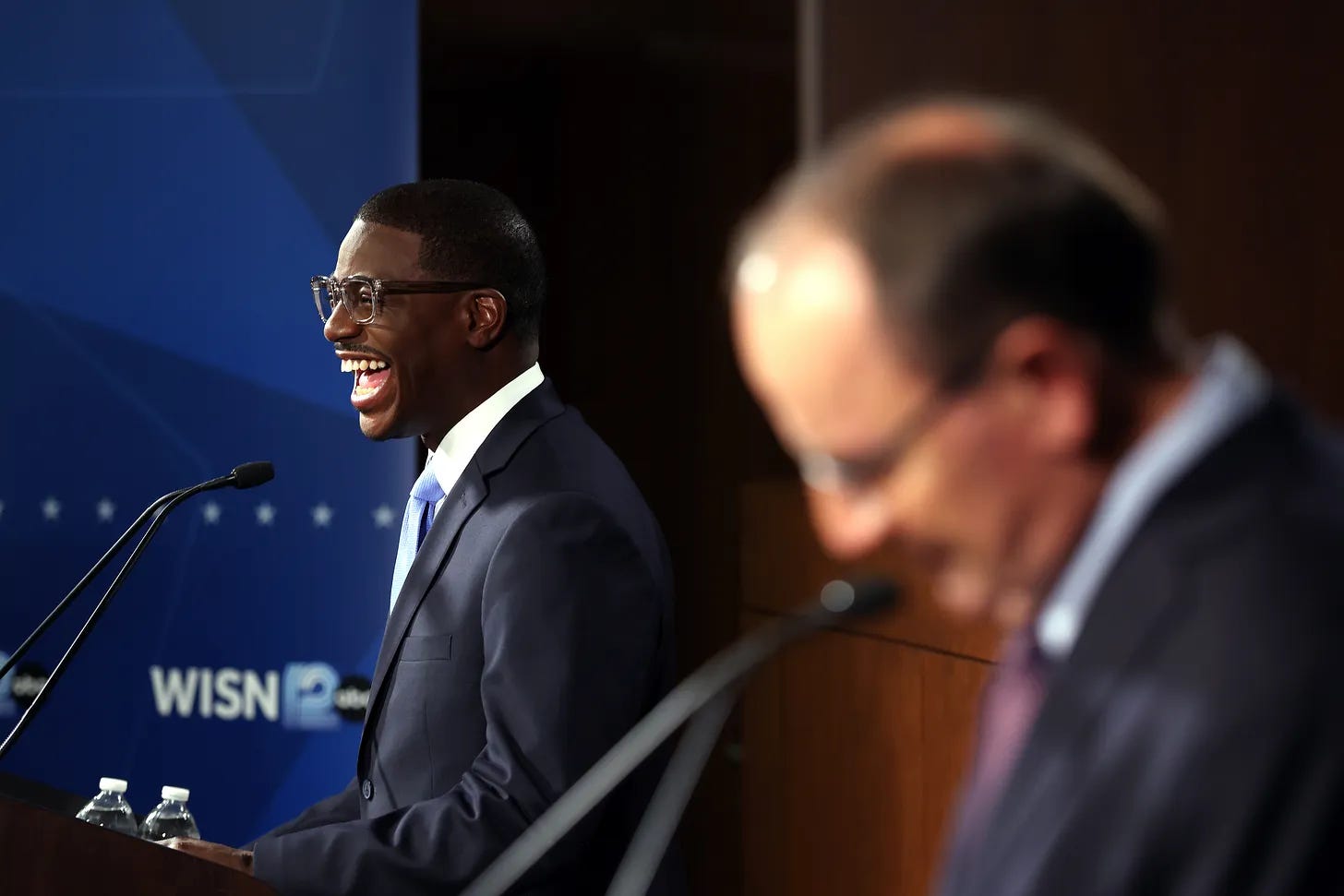
Typically, when putting together these breakdowns of the Marquette University Law School Poll results, I find the head-to-head results that dominate the traditional media headlines less interesting than the rest of the poll.
The under-the-hood details — issue-specific results, favorability ratings, other notable trends — provide more valuable information. Those kinds of results can be especially important in understanding how a campaign unfolds, what issues are emerging, and what voters are thinking. This is what separates the Marquette poll from so many others — the in-depth information that goes well beyond the horserace headline. Focusing on these types of down-poll issues helped us understand what has really mattered in these campaigns and has sharpened our analysis of issues from data centers to democratic socialism to property taxes to immigration to school funding.
But now that we’ve arrived at the final poll of 2026, this is when that top result really matters. To that end, the headline is this:
David Crowley is the favorite to win the race for governor in Wisconsin.
Throughout this election cycle, I have been hesitant to identify either candidate as a favorite. I think every fall election in Wisconsin should be considered a toss-up. There’s just too much recent history that has shown that, more often than not, it’s going to be close. Five of the last seven presidential elections in Wisconsin have been decided by less than 1%. The last two races for U.S. Senate in the state proved to be the two closest in 100 years, each decided by 1% or less. Tony Evers’ re-election victory in 2022 was called a “Wisconsin landslide,” and that victory came by only a 3.4% margin.
But now, it’s clear: David Crowley has the edge over Tom Tiffany in this race. This poll shows the Milwaukee County Executive leading the Republican congressman 51% to 44% with likely voters. Getting over 50% is key for any candidate in final-stretch polling, and that seven-point margin is significant.
That seven-point lead for Crowley is bigger than any I’ve seen in pre-election polling for a statewide fall election in the seven years I’ve been writing analyses of Marquette poll results.
In 2024, the final Marquette poll of the cycle showed Kamala Harris up 1 point against Donald Trump and Tammy Baldwin up 2 points over Eric Hovde. In 2022, it showed Ron Johnson up 2 points over Mandela Barnes, and Tony Evers even with Tim Michels. The 2020 poll showed Joe Biden with a five-point lead over Donald Trump. While polls can be and have been wrong, these numbers for Crowley are stronger than those of anyone who has won a statewide election in Wisconsin so far this decade.
Crowley has led in every head-to-head poll against Tom Tiffany since winning the chaotic August primary, and is expanding his lead in the final poll before the election. He is in position to win this race.
So, why has Crowley been able to grow his lead over Tom Tiffany in these closing weeks?
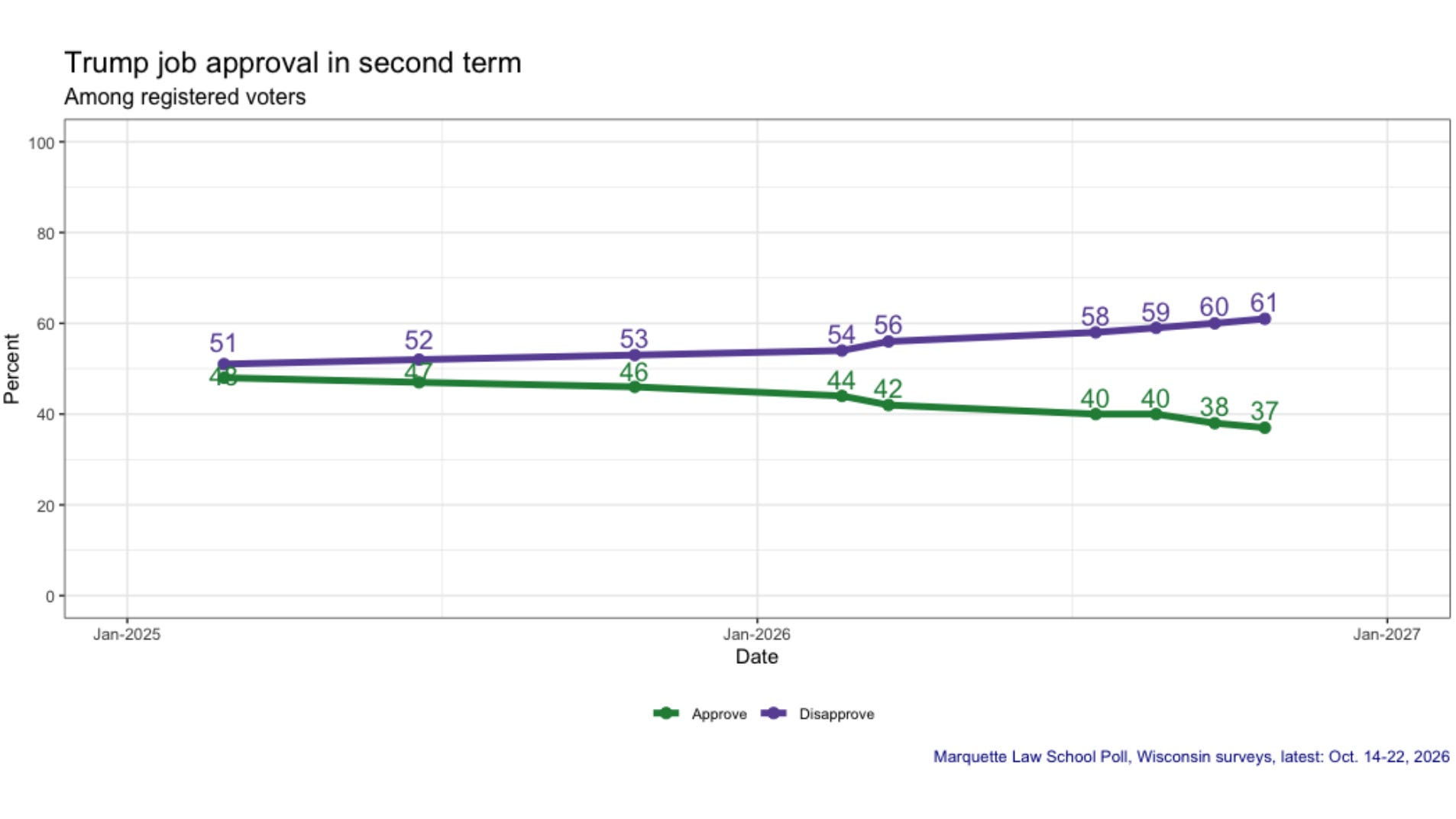
For one, the national environment and Donald Trump’s cratering approval ratings cannot be ignored. Trump has again posted his worst approval rating in the state across his two terms in office — 37% approve to 61% disapprove — and independent voters are swinging hard against the president and his party. Just 14% of independent voters approve of Trump, to 79% disapprove. Those are staggering numbers.
Since most voters connect Tom Tiffany with Donald Trump — with good reason, since he has supported him about 100% of the time in his second term, and ran to “be the ally Donald Trump needs” in his first bid for Congress in 2019 — that’s been bad news for Tiffany.
The history of midterms also says that the party that does not control the White House almost always does better in those fall elections. That was the case in 2022 and in 2018, and has been the trend for just about every election in the modern era. Between 1934 and 2018, the president’s party gained seats in both the House and Senate only twice. But Trump’s approval ratings are worse than they were at this point in his first term, and are worse than Joe Biden’s poor approval ratings in 2022.
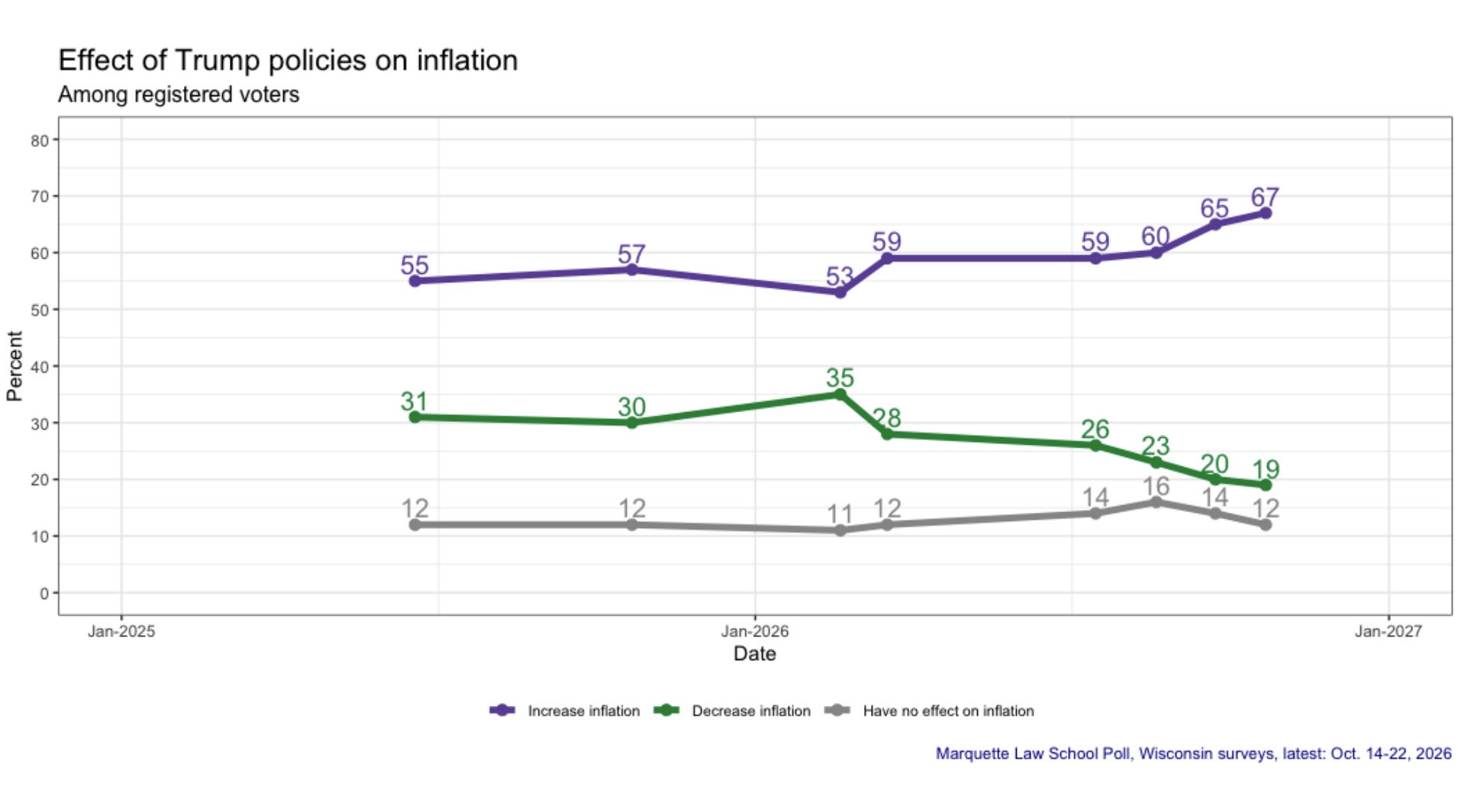
Trump’s marks on the economy are extraordinarily bad. More than two-thirds of voters say Trump’s policies have increased inflation, more than 90% of voters say gas prices are up, overwhelming majorities say Trump’s Iran war has neither achieved its goals nor been worth the cost, more than 80% of voters say grocery prices are up, sizable majorities are opposed to tariffs on Canadian goods, and 70% of voters say tariffs are hurting Wisconsin farmers. More people say they are worse off (42%) than say they are better off (16%) than a year ago.
There is a strong chance that Trump’s Republican Party is headed for an electoral wipeout just on these metrics alone.

Crowley has been able to capitalize on this in Wisconsin, but he’s also demonstrated his strength as a candidate in his own right. He has been able to unite the factions of the Democratic Party in a unique way.
Despite the fraught Democratic primary that the Milwaukee County Executive won by a narrow margin over State Rep. Francesca Hong, Crowley polls with 100% support among the wing of the party favorable to democratic socialists, and 93% among non-democratic socialists.
Crowley has campaigned and governed as a bridge-builder, and whether it’s getting things done with leaders from across the aisle in his role as Milwaukee County Executive or uniting factions of the party after this contentious primary, he’s proving to be skilled at bringing people together. Perhaps he is the type of candidate who can bring together progressives and moderates and overcome the intraparty debates that have long plagued Democrats.
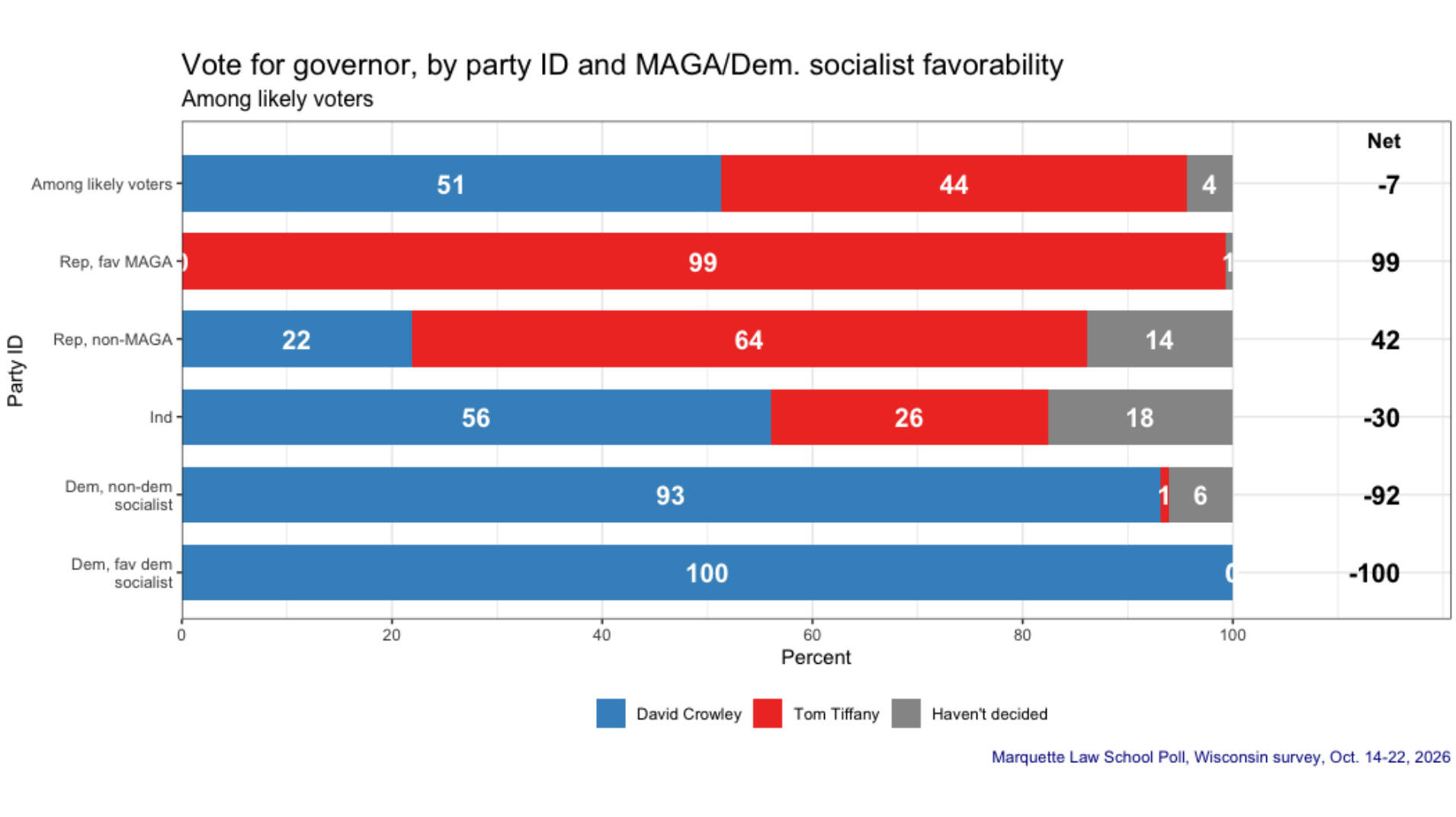
In fact, it’s Tiffany who is the candidate struggling to unite his party. While the Northwoods congressman has near-unanimous support from MAGA Republicans, he’s lost support among significant factions of those who consider themselves non-MAGA Republicans — 22% of whom said they’re now backing Crowley, with another 14% undecided.
While Crowley’s favorability numbers dipped in September — following the inevitable onslaught of billionaire-funded attack ads — he has rebounded in this poll, bringing his net favorability numbers up by several points. Tiffany’s net favorability numbers, on the other hand, have continued to slide, now at a net minus-10.
One of the biggest differentiators between the two candidates is among independent voters. In the head-to-head polling with Tiffany, Crowley is dominating with independents — 56% for Crowley, just 26% for Tiffany (with 18% still undecided). Crowley is also well ahead with moderates, 64% to Tiffany’s 28%, with 9% undecided. Moderates tend to go for Democrats in Wisconsin, but Crowley is clearly winning the center, with another metric showing far more voters seeing Crowley as the moderate candidate in this race.
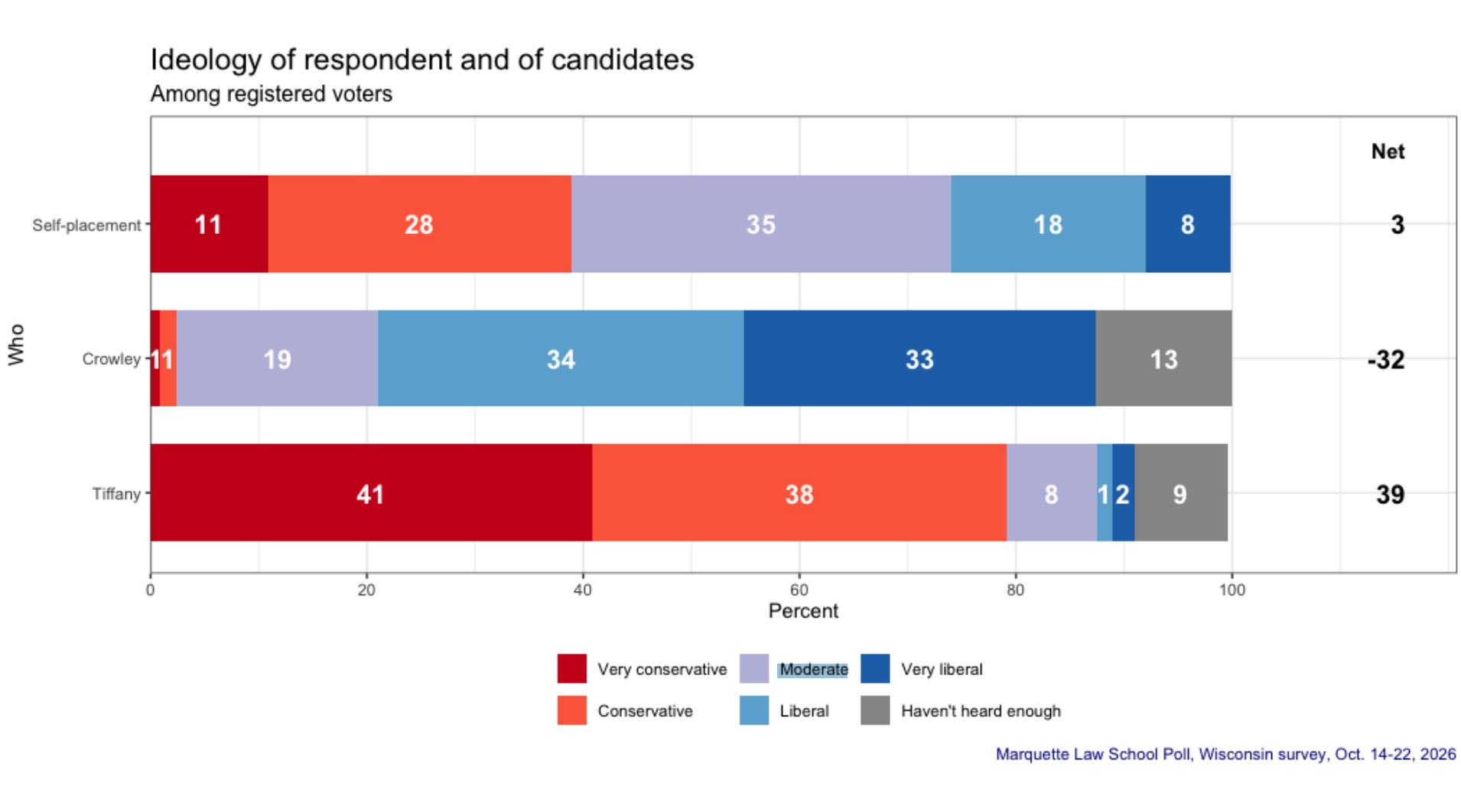
While Crowley deserves credit for these strong results, part of this also reflects on Tiffany and his campaign. These results suggest that Tiffany has put too much emphasis on playing to his base rather than running a general-election campaign that wins over independent, moderate or swing voters.
This shows in Tiffany’s support of Trump — 87% of voters say he’s supported the president all or most of the time — but it appears on other issues, too. He and Republicans have prioritized ending Tony Evers’ “400-year veto,” and while a slight majority say this veto means tax increases — 52% to 46% — independent voters say this veto was necessary for schools by a 10-point margin. Charles Franklin even noted during the poll presentation that this is an issue that plays to Tiffany’s conservative base, suggesting it is not significantly resonating beyond it.
Tiffany is not a moderate by any stretch of the imagination, and he has made no attempt to even pretend to run as one.
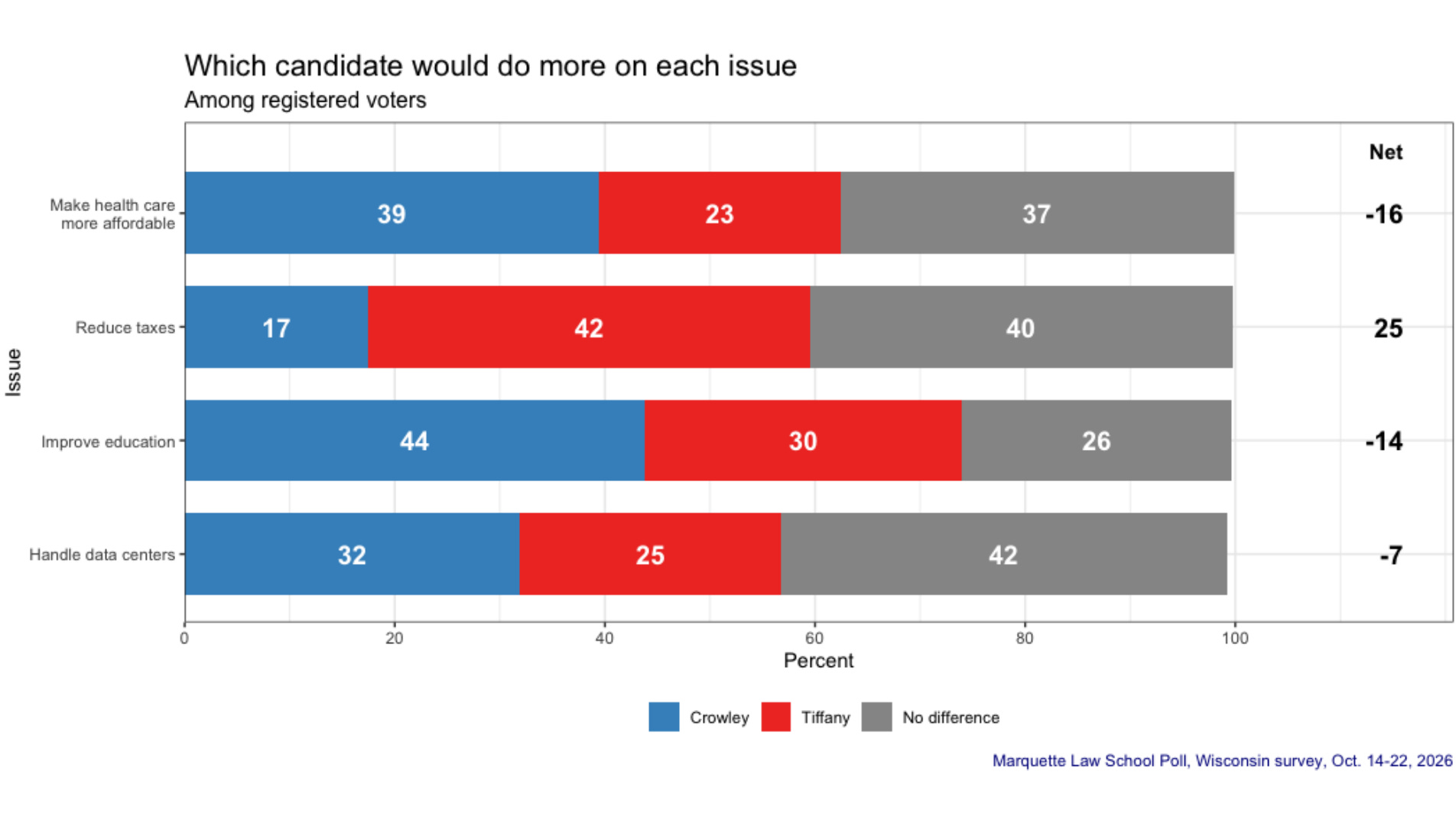
Tiffany’s strongest marks in the poll are on his support for tax cuts, but on other issues — health care, education and even data centers, where much has been made of Crowley’s stance — voters are largely siding with his Democratic opponent.
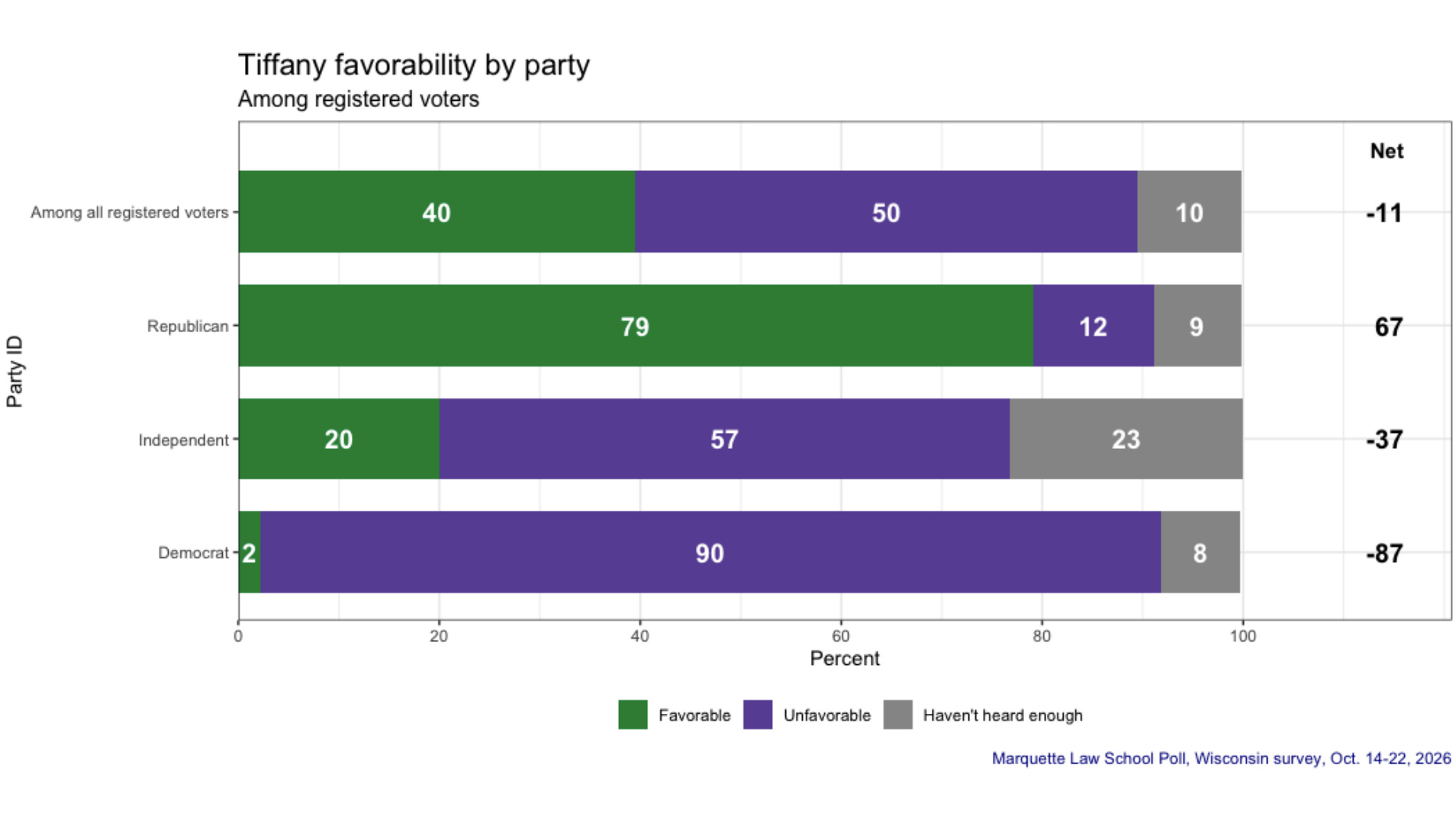
Tiffany also polls especially poorly with independent voters. Just 20% of independent voters have a favorable view of him to 57% unfavorable.
His net minus-10 favorability rating looks even worse in the crosstabs. He’s viewed as a net negative by voters in every age group and income level, and by both men and women. His favorability had been fairly positive among Gen X voters in the 45-59 age group throughout, a group that tends to be the most Republican-leaning generation in the Trump era, but even that has slipped to a net minus-4.
Another story here is how the gender divide is shaping up in this race. Typically, most men support Republicans and most women support Democrats. But in this head-to-head poll, Crowley has a 13-point edge with women, not an uncommon mark for Democratic candidates, and also has a slight edge with men — 49% to 48%.
There’s also a huge generational gap in this poll, where the 40-year-old Crowley leads the 68-year-old Tiffany by 20 points or more with voters in the 18–29 and 30–44 age groups. But the Milwaukee County Executive is only slightly behind with voters over 45.
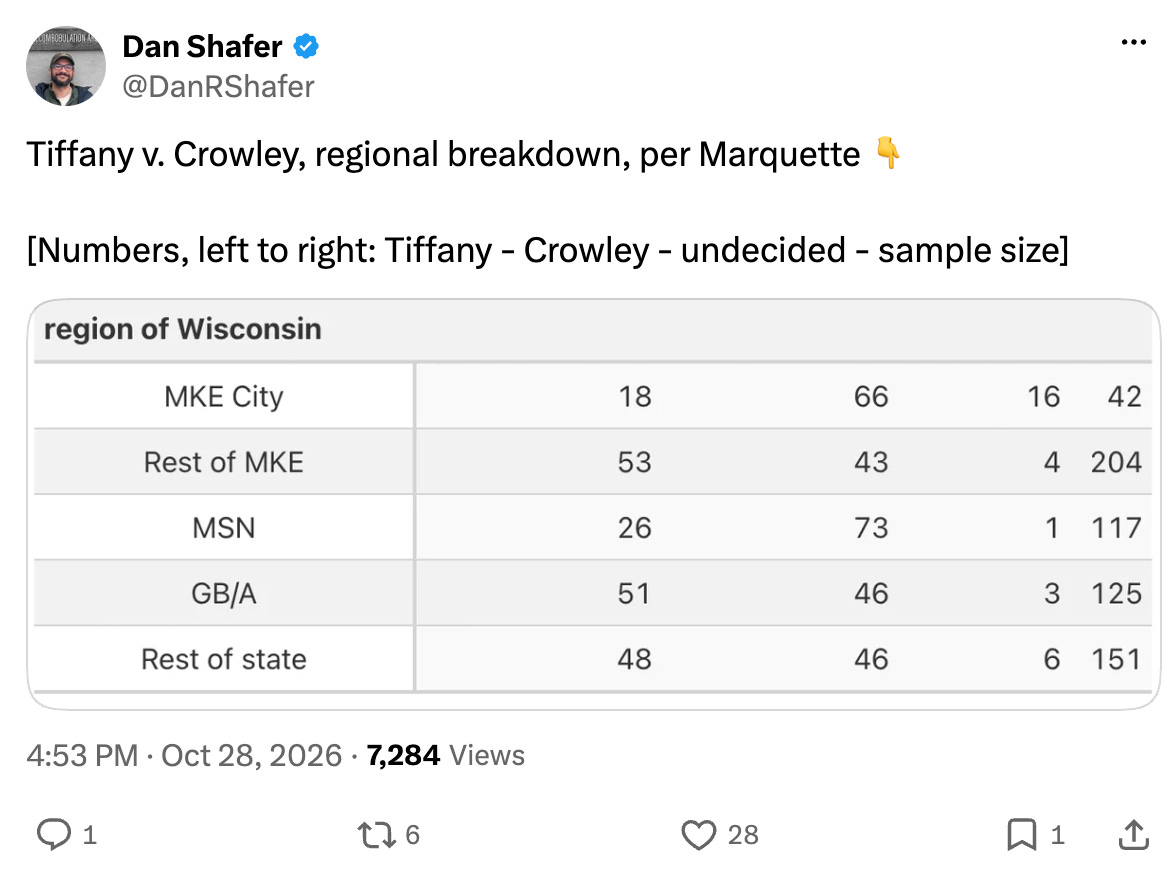
Tiffany is also doing especially poorly in the city of Milwaukee in this poll. Perhaps that’s not surprising, since he’s running such a decidedly anti-Milwaukee campaign, but his favorability marks1 in the city are a net minus-36, with just 16% of city voters viewing him favorably. There are more Milwaukee voters who have no opinion of Tiffany than have a positive opinion of him.
Crowley, on the other hand, is quite well-liked in his hometown. He has a net plus-34 favorability rating in the city, an especially good mark and quite a bit better than that of the last Milwaukee candidate to run statewide, Mandela Barnes. Barnes’ favorability in the final three polls of the 2022 race showed him with a net plus-27, and his results in the city were a bit of a disappointment in his loss to Ron Johnson. If Crowley can drive even stronger numbers in Milwaukee — a place currently enjoying quite the moment, with the Brewers in the World Series — that could help power an electoral victory.

The bottom line is that whether you’re looking at the topline number where Crowley leads by seven points or digging through the crosstabs, this is a very, very good poll for the Milwaukee County Executive, and a bad one for Tom Tiffany and the Republican Party.
These final pre-election polls are often quite revealing. In 2024, the final poll showed the race tightening at the top of the ticket, and we saw the split result of Donald Trump and Tammy Baldwin each winning statewide. In 2022, Barnes had a strong close, but was still the underdog going into Election Day, and the governor’s race showed a tight contest — one in which Tony Evers was ultimately a bit underestimated. This one shows Crowley, who has had a wire-to-wire lead since the primary, improving his margins in the closing weeks.
Any way you slice it, David Crowley now has the edge against Tom Tiffany in the race for governor.
However, as Charles Franklin says at every final pre-election poll presentation, “Polls don’t vote. People vote. The election is in your hands.”
ICYMI: See more recent podcasts, feature stories, breakdowns and more at The Recombobulation Area:


To get a more representative result of city of Milwaukee polling data, I grouped together the last three polls to get a sample size large enough to provide meaningful results.
Very helpful breakdown. Thanks, Dan!