

The Recombobulation Area is a 19-time 21-TIME! Milwaukee Press Club award-winning opinion column and online publication founded by Milwaukee journalist Dan Shafer.
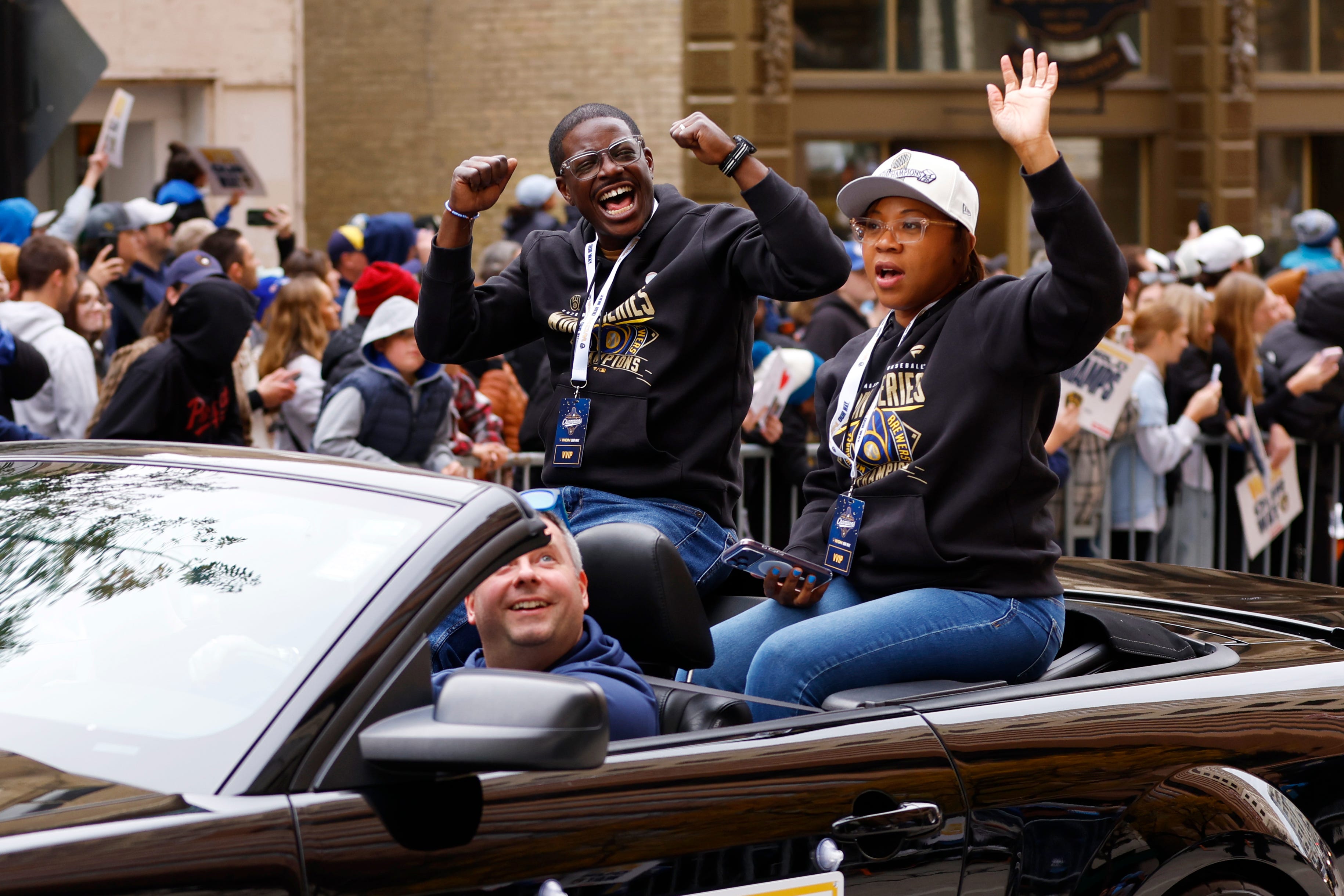
The Milwaukee Brewers have won the World Series. Yes, that really happened.
This has been a remarkable time for the great city of Milwaukee in so many ways, and celebrating this joyous moment has brought so many people together. It’s been truly incredible to see.
The timing of this championship victory — the first in Brewers history and the city’s first World Series in 69 years, since the Milwaukee Braves won in 1957 — is also quite something. The politics of this moment have been far from the forefront of Wisconsin’s attention during this magical playoff run, but it has also been unavoidable.
When you have an everything-on-the-line election like the one happening just next week, that’s bound to happen. Spending in the governor’s race has been astronomical, shattering records with already more than $166 million poured into the governor’s race alone. Politics have been a continued presence in the background, with non-stop ads in commercial breaks during many of these games.
But part of it has been in the foreground, too. The Democratic candidate, Milwaukee County Executive David Crowley, has been campaigning on his role in the negotiations to keep the Brewers in Milwaukee through 2050.
At an Oct. 15 Marquette University event, Crowley said, “I’m the reason why the Brewers are still here in Milwaukee.”
While some might quibble with some of the technicalities of that statement, it’s undeniable that Crowley and his administration played a significant role in getting the deal done, since it involved not only action from the governor and state legislature, but from the City of Milwaukee and Milwaukee County, too.
Even the Republican state representative who was the bill’s lead author in the Assembly, State Rep. Robert Brooks, credits Crowley’s work on the deal, saying on the record to the Journal Sentinel for an Oct. 27 story, “We needed a commitment from [the city and county] for a percentage of the funding. It was a tough negotiation, but we got it done. David was a big part of that. He was a true partner in this.”
At the Brewers’ “Parade of Champions” in downtown Milwaukee on Friday, Oct. 30, a plane flew a sign overhead that read, “DAVID CROWLEY HELPED KEEP THE BREWERS IN MILWAUKEE.”


On the campaign trail, Crowley has been wearing Brewers gear non-stop, and there have even been Crowley campaign signs in Brewers blue-and-yellow.
Perhaps it’s a good thing to be associated with such a team at this moment, and also perhaps a bit of a problem for Republican candidate Tom Tiffany, who has been running a decidedly anti-Milwaukee campaign since Crowley won the Democratic primary in August. The latest polling shows Crowley growing his lead from September to October.

So, what exactly did David Crowley do for Milwaukee County the Brewers stadium deal that was signed in 2023?
Not only was the Milwaukee County Executive a key player in these negotiations, but Crowley and his administration turned what was proposed to be a $500 million long-term net cost into an agreement that will actually bring in more money to County coffers over the life of the deal. It’s an under-the-radar policy wonk success story.
Stadium deals like this can be complicated and controversial. But the Crowley administration advocated for a pair of technical changes — both somewhat unrelated to the actual funding of repairs and other needs at American Family Field — that transformed the deal into one that would keep the Brewers in Milwaukee without bringing expensive long-term financial obligations to the County.
These technical changes had to do with 1) giving the County greater financial flexibility to address its pension debt, and 2) reducing an administrative fee for sales tax collection paid to the state’s Department of Revenue, freeing up more local dollars. But this required some creative dealmaking from the Crowley administration.
Here’s what happened.
I recently sat down with Alec Knutson, who served as the Director of Government Affairs at Milwaukee County for more than six years — most of those under County Executive David Crowley.
Knutson praised Crowley as a bridge-builder, saying, “That’s not just a campaign line. That’s really core to his approach,” adding that he had developed relationships with people across the political spectrum in Madison in efforts to get things done.
“That is his superpower,” said Knutson. “Not everyone is like that.”
When the Brewers deal was first presented to the County, Knutson was squarely in the mix for these negotiations in 2023 — which came at a fraught moment for Milwaukee County.
As part of Crowley’s administration, Knutson had played a key role in the efforts to secure the County’s financial future. He began this work when hired under former County Executive Chris Abele in 2019, and continued that work under Crowley, where he served in that role until 2025. The legislation he was working on eventually became Act 12, the shared revenue reform and local sales tax bill that passed in 2023. This was a major achievement for Milwaukee County and for the Crowley administration, and helped avoid what would likely have been a full-blown fiscal crisis and major cuts to every level of County government.

Shortly after that contentious and complex deal passed in June of 2023, the proposed deal to continue funding the state-owned stadium through 2025 was brought to the County, Knutson said. These initial proposals had major financial implications for a unit of government that had just dug its way out of a major financial hole.
“The difficulty we just had going into the Brewers deal was, we just spent time, political capital and many years to get (Act 12) over the finish line — it was massive, and we’re still not out of the woods,” he said. “But, guess what, here’s the first crack at the Brewers (stadium) deal, it’s actually going to cost the County $500 million over the next 20 years.”
Knutson said that because this deal was a priority for Gov. Evers and it had the framework of a bipartisan agreement with Republican legislative leadership, a bill was more or less “ready to go.” The County would have to act fast.
At fast it did. Knutson said, “in short order, we went from a $500 million negative impact to a close to $200 million positive impact for the County.”
Initial proposals for this deal showed the local contribution from Milwaukee, both City and County, at more than a combined $200 million over the 27-year life of the deal — $2.5 million annually from the City, and $5 million per year from the County.
This created challenges for the County, and in documents Knutson shared with The Recombobulation Area, there were certain aspects of the proposal that would have made it so Milwaukee County would not have supported the deal.
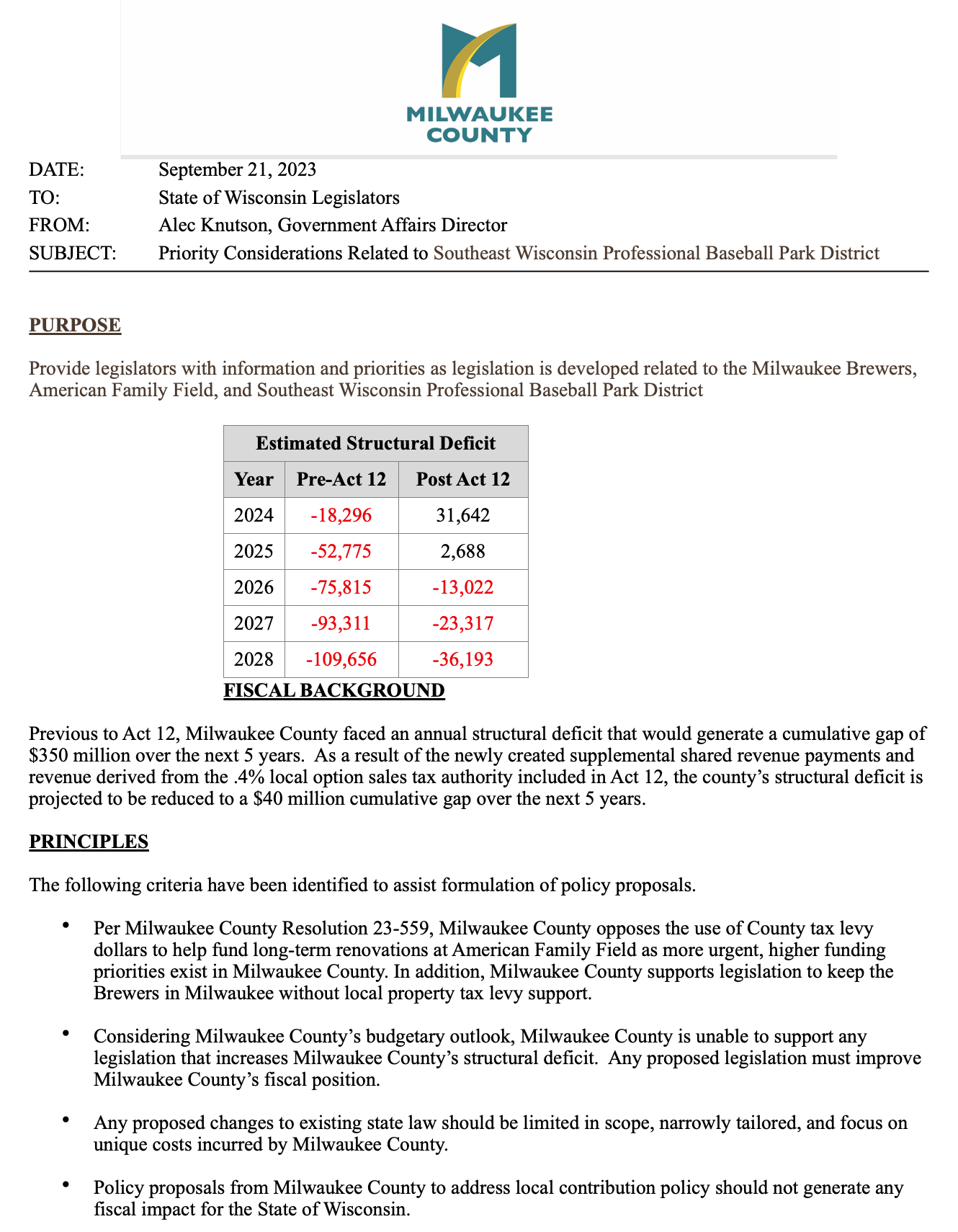
A Sept. 21, 2023, briefing document from the County outlined how any Brewers deal needed to “improve Milwaukee County’s fiscal position.”
This referenced a Milwaukee County Board resolution that opposed any use of property tax levy dollars to fund the stadium district, and stated how the County’s structural deficit — reduced by hundreds of millions of dollars through Act 12, but still projected in the years to come — would need to be unaffected by this stadium deal.
“Considering Milwaukee County’s budgetary outlook Milwaukee county is unable to support any legislation that increases Milwaukee County’s structural deficit. Any proposed legislation must improve Milwaukee County’s Fiscal position,” it read.
One of the requests in this document included reducing Milwaukee County’s local contribution to $2.5 million, a piece that was included before the deal passed the full Assembly.
For the other requests, here’s where it gets wonky — but the wonkiness was critical to the end result.
“It wasn’t this idealistic set of expectations that we knew couldn’t get addressed,” said Knutson. “It was hard, nuts and bolts — here’s some real technical stuff that could get fixed that will have a material impact on local government or people’s lives.”
The first of these was needing to deal with “part of the pension problem,” said Knutson. The County’s crippling pension scandal from the early 2000s was still having an impact in the early 2020s. Along with the sales tax and shared revenue part of the Act 12 legislation was a change in the pension arrangement for Milwaukee County, transitioning employees from the Milwaukee County Employee Retirement System (ERS) to the state’s Wisconsin Retirement System (WRS).
Act 12 had with it certain Milwaukee-specific restrictions on how this Milwaukee-specific sales tax revenue could be spent. This technical change that was included in the Brewers deal allowed new sales tax revenue from Act 12 to be used for this pension system transition. This change was made official on Jan. 1, 2025, Crowley announced.

The second technical change had to do with sales tax collections.
The state of Wisconsin has a base rate of its sales tax of 5.0%, and each county can levy an additional 0.5% rate, which 70 of 72 counties now do (Waukesha and Winnebago are the only that don’t).
The state Department of Revenue had imposed a 1.75% administrative fee to collect any local option sales taxes. Through this Brewers deal, though, that fee was reduced to 0.75%. Documents show that change would generate a projected $2 million for Milwaukee County in 2024 alone, and an additional $78 million over the life of the deal. This change also impacted every county in the state.
Knutson said “those two provisions were some of the most important” for getting the deal done from Milwaukee County’s side.
“We were able to completely flip the script in such a dramatic fashion in such a quick time frame when there was no avenue to do it, “ he said.

At that Marquette University event earlier this month, Crowley discussed that piece of the deal,
“We were able to negotiate a deal with the Republican-controlled legislature and with Gov. Evers at the helm, with the City of Milwaukee, and it wasn’t just about keeping the Brewers here,” he said. “Because of the deal that we did, throughout the 30 years of the deal, we’re going to actually see about $280 million in flexible revenue coming back to Milwaukee County.”
I brought up Crowley’s statement — that he was the reason the Brewers are staying in Milwaukee — and asked Knutson: Is that an accurate characterization?
“We were told by the Brewers that if we can’t get this done, we are leaving Wisconsin,” Knutson said. “That was real.”
Knutson said that led to “analyzing this deal through a policy lens,” not just as fans of the team. That meant things like economic impact, potential demolition costs (an estimated $300 million), other additional factors, ultimately determining that yes, they wanted to be on board with the deal. That led to the negotiations that followed, and the technical changes that made the deal palatable.
So, is Crowley the reason the Brewers are staying in Milwaukee?
“Yes, is the direct answer to your question,” said Knutson. “I was in the room and I saw it happen. David (Crowley) was the first one to be brought in from a local perspective for getting this done. And there’s a reason for that.”
In the initial proposal of the deal, said Knutson, “We were going to have to pay every year out of our limited amount of resources.” That would have impacted “parks, senior centers, (transit)” and more, he added.
Instead, the deal that was signed both kept the Brewers in Milwaukee and kept the County budget in a stronger position.
“This flipped the script,” Knutson said. “It’s a testament to David’s skillset.”
Dan Shafer is an independent journalist from Milwaukee who writes and publishes The Recombobulation Area. He worked with Civic Media from 2024 to 2026. He’s written for The New York Times, The Daily Beast, Heartland Signal, Belt Magazine, WisPolitics, and Milwaukee Record. He previously worked at Seattle Magazine, Seattle Business Magazine, the Milwaukee Business Journal, Milwaukee Magazine, and BizTimes Milwaukee. He’s won 24 Milwaukee Press Club Excellence in Journalism Awards. He’s on Twitter at @DanRShafer.
Subscribe to The Recombobulation newsletter here and follow us on Facebook and Instagram at @ therecombobulationarea.
Already subscribe? Get a gift subscription for a friend.
Part of a group who might want to subscribe together? Get a group subscription for 30% off!
Follow Dan Shafer on Twitter at @DanRShafer, at BlueSky at @danshafer.bsky.social, and on Threads at @danshafer.