

The Recombobulation Area is a 19-time 21-TIME! Milwaukee Press Club award-winning opinion column and online publication founded by Milwaukee journalist Dan Shafer.
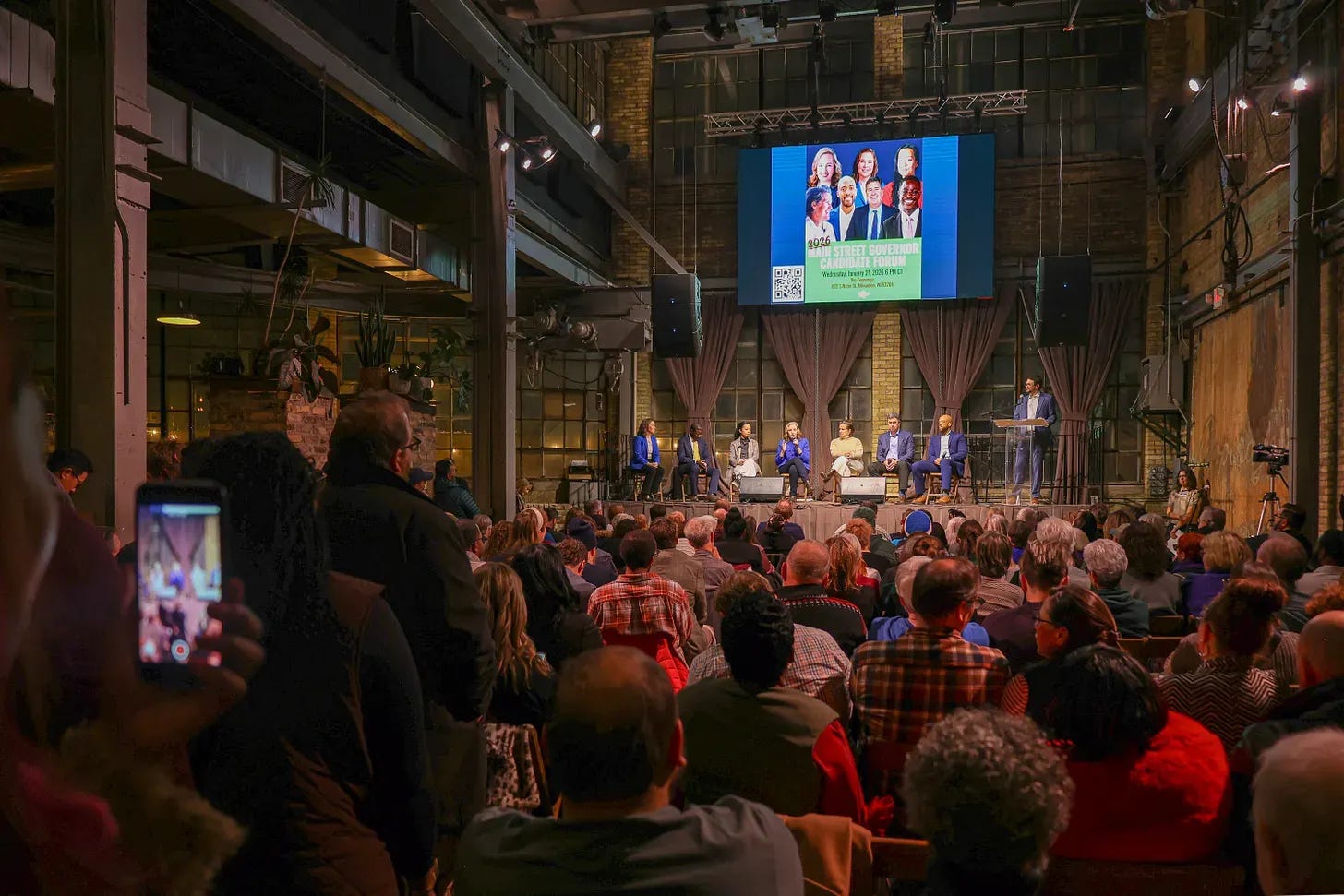
This year’s election for governor is a must-win for Wisconsin Democrats, who hope to gain a state trifecta for the first time since 2010, in promising political conditions. Republicans have coalesced around MAGA Republican Tom Tiffany, who aided Donald Trump’s illegal efforts to overturn his legitimate 2020 presidential loss.
Democratic voters will choose their nominee in the Aug. 11 primary, with early voting already underway. State Rep. Francesca Hong, a Democratic socialist, has increased her lead to more than 20 points in polls of the primary field, with similar strength in all parts of the state, followed by David Crowley, Kelda Roys, and Joel Brennan. Democratic voters naturally want to choose a nominee who shares their values and can win.
Hong’s opponents are trying to slow her momentum by arguing strategy more than values or policy. Crowley, for example, says Republican hopes for a Hong nomination mean she will be easier to defeat this fall.
But Crowley assumes too much Republican savvy. The best political science evidence we have suggests all the party’s candidates are similarly favored to beat Tiffany in a fairly close contest, and no Democrat is clearly “safer” than the others.
Nothing is guaranteed, and anyone claiming certainty is misleading us, but these are the likeliest conclusions based on a range of evidence I’ll walk through here. The main ideas are as follows:
Political conditions favor Democrats, pointing to a wave election
Those fundamentals matter much more than candidates and campaign choices
Progressive candidates do just as well as moderates
Wisconsin voters like progressive policies (but most voters don’t vote on policy)
Polling hypothetical general election matchups now isn’t predictive for November
Wave elections
In the current political environment, all Democratic gubernatorial candidates would be favored to win, albeit in a fairly close election – perhaps a margin of 0-to-5%.
President Donald Trump is historically unpopular, and an unpopular president’s party almost always loses ground in congressional and state-level elections in a midterm election, driven especially by differential turnout. And the wave, combined with the electorate’s underlying partisanship, tends to lift all the candidates in that party. These “fundamentals” set the narrow range of likely outcomes in which candidate and campaign differences might matter (but often don’t).
Off-cycle elections in 2025 and 2026 in Wisconsin show a likely Democratic wave. With Trump off the ballot, Democrats (let’s be honest) won the 2025 Wisconsin Supreme Court election by a 10-point margin, and the equivalent 2026 election by 20 points. But Democrats are unlikely to equal those margins in the higher-turnout midterms.
Marquette polls show President Trump is more unpopular among Wisconsin’s registered voters now (-19 net favorability) than he was at this time in 2018 (-8 net favorability), suggesting a bigger Democratic wave this year in Wisconsin.
Polling on the generic U.S. House ballot shows a 7.2% national advantage for Democrats now, largely similar to a 4-to-7-point Democratic advantage in summer 2018. And views of Wisconsin’s outgoing Democratic governor Tony Evers remain more favorable than not.
Even in wave years, candidates from the same party can win with different numbers of votes, often with an incumbency advantage. There is no incumbent in this year’s election for governor, so the general wave is more likely to apply.

Progressive candidates do as well as moderates with voters
Distinctions between candidates within a party don’t matter much. Most notably for our case — and contrary to common punditry — the best evidence shows moderate candidates don’t win more votes than progressives.
Many strategists assume everyone is an ideologue, everyone pays close attention to campaigns, voters choose based on issue preference, and the candidate who takes positions closest to the “median voter” on those policies wins. None of that is true.
Why? Most voters aren’t ideological, and the exceptions to this rule are impervious to persuasion. Even in primaries, seemingly obvious ideological coalitions often fail to materialize. For example, Hillary Clinton’s 2016 primary voters were similar or left of democratic socialist Bernie Sanders’ voters on some economic policies but were substantially different on age, ethnicity, and their lesser attachment to the Democratic Party.
Voters generally don’t choose based on policy. Americans are much more likely to adopt their favored candidates’ positions than vote for a candidate based on policy views.
As Ben Wikler notes (among many others), voters care most about outcomes – making life better for people – much less about the policy details to get there. And so when voters feel the country is on the wrong track and life is getting worse, they punish the incumbent party. Voters tend to punish the president’s party more than they do the governors’ parties.
Beyond that, the public’s political views come from their feelings toward social groups by class, race, religion, gender, and sexuality, and adopting views of friends and family.
Put differently, Hong winning the general election would signal a big change for the Democratic Party in Wisconsin and beyond, but for most voters — less aware of these inside baseball arguments — it would be just another day at the ballot box.
Even if ideology did matter for winning, Republicans are nominating a right-wing authoritarian, which frees Democrats to choose a candidate who best reflects their aspirations for a freer and fairer Wisconsin. It makes sense for Democrats to highlight Tiffany’s extremism and their own popular Democratic visions, but ideology won’t be as big of a factor.

Winning midterms is more about turnout than persuasion
Midterm elections that punish an unpopular president’s party are driven by differences in enthusiastic turnout more than persuasion, though the turnout disparity is less in highly competitive elections. Wisconsin Democrats are already much more motivated to vote this year than Wisconsin Republicans, according to a recent Marquette poll.
Non-voting gets little attention in election discourse, even though non-voting is the most popular choice. In the 2022 U.S. Senate race, 43% of eligible Wisconsinites didn’t vote, far more than the 30% voting for each party’s candidate.
Some of those people probably can’t reasonably be mobilized, either from total disinterest or barriers to voting. But many are disaffected and would vote for Democrats (or Republicans) if they felt a party would meaningfully improve the lives of people in their community and beyond.
As Anat Shenker-Osorio argues, you need a cause that draws people, a clear contrast with the opposition, and to meet people at their broadly shared values. And you do that with a message people are excited to share, because ordinary people are the most effective advocates.
Which Democratic candidate is most likely to motivate voters to turn out? If there is a difference between candidates, Hong seems to have an edge with energy from progressive groups and young people. She has positioned herself as a “change” candidate at a time when the general public and the Democratic base are deeply dissatisfied with the status quo.

What about “Democratic Socialism”?
Wisconsin has a long history electing progressives and socialists going back to “Fighting Bob” LaFollette, the Progressive Party, and Milwaukee’s socialist mayors — as Wayne’s World fans know well. Their ideas were later adopted by New Deal Democrats, including Social Security, unemployment insurance, and public housing. Democratic socialists seem to be continuing that approach in Wisconsin, New York, Colorado, Kentucky, and elsewhere at local and state levels.
Some Democrats worry Hong’s embrace of the “Democratic Socialist” label could cost her votes. The July 22 Marquette poll shows only a quarter of registered voters have a positive view of the name, half have a negative view, and another quarter don’t know. Among Democrats, 54% have a favorable view and 10% are unfavorable.
Long story short, though, Hong’s candidacy is likely to improve public perceptions of the label by defining it with her popular vision, rather than her losing votes because of it.
Most voters don’t choose candidates because of policy, but many Wisconsin voters do like the policies of progressive Democratic candidates — and Hong’s, in particular.
Among the 1,168 Wisconsin respondents in the 2024 Cooperative Election Survey (YouGov), 75% supported expanding Medicaid1, 66% supported raising taxes on the rich2, 58% supported more healthcare spending, 55% supported raising corporate taxes3, and 55% supported more education spending.
Beyond affordability, 66% of Wisconsinites supported same-sex marriage, 57% supported abortion access without any limits, and 55% supported granting legal status to undocumented immigrants. Only 26% of Wisconsinites supported arming Israel.
Most voters don’t know, use, or care about standard ideological labels except as synonyms for the two parties (if that). “Democratic socialist” is even more obscure, and Cold War hysteria is antiquated. More directly, a recent Cato study found that candidates were as likely to gain as lose support because of the label in a national survey.
Counterintuitively, Hong’s use of “Democratic socialist” may actually help distinguish her from “establishment” Democrats and a party brand more toxic than Republicans’ in Wisconsin.
Republicans have also begun calling Democrats “communists,” showing that their messaging won’t discern between Democratic candidates, regardless of chosen labels.
Interpreting Marquette Polls
Marquette University polls, led by Charles Franklin, are the clearest quantitative evidence we have on where the campaign stands now, but they come with several important caveats. [Full disclosure: Charles was my undergraduate adviser in college.]
Marquette polls sample registered voters, but Wisconsin has same-day registration, and Hong’s strongest support is from young people and folks disgruntled with the usual Democratic candidates who are less likely to be registered. That means Hong’s primary and general election support could be underestimated in the polls. Those groups are admittedly lower-turnout groups, but currently unregistered voters could be decisive in November.
Polls won’t become strongly predictive of November voter behavior until early fall, when normal people start paying attention (sorry, nerds!). Most Wisconsinites couldn’t even name the candidates now. Presidential polls typically aren’t predictive until September, moving into line with the fundamentals, though earlier polls may be growing more accurate in recent years.
The range of results for hypothetical general election matchups is largely within the margin of error – the Democratic candidates were statistically indistinguishable from each other against Tiffany.
Getting representative survey samples in Wisconsin is hard these days. All the polls seem to be moving similarly, which is a good sign, but they may all be picking up similar biases due survey recruitment challenges.
Beyond 2026
In this year’s midterm elections, Democrats hope to set the party up for future electoral successes, including strong results in years that don’t favor Democrats like this one.
Former Democratic Party of Wisconsin chair Ben Wikler’s guidance is especially on point with ideas for building a strong party organization, including a focus on local relationships, face-to-face interactions, and non-stop organizing and visibility for the party statewide.
But, beyond improving party organization and messaging, Democrats in government will need to show voters they can meaningfully deliver more wellbeing for all Wisconsinites. To change public views of the party longer term, Democrats will need to make noticeable change from the unpopular status quo, which will also require effective leadership to guide that vision through the state legislature and be implemented well.
Democratic voters naturally want a nominee who shares their values and can win. The best evidence we have suggests any of the Democratic candidates can win in November. The main question facing Democratic voters, then, is this: which candidate has the vision and leadership to deliver what Wisconsin needs?
Nathan Kalmoe is Executive Administrative Director of the Center for Communication & Civic Renewal at the University of Wisconsin-Madison. He is co-author of Neither Liberal nor Conservative: Ideological Innocence in the American Public. His current book project is How We Make American Democracy: A Practical Guide to a Free & Fair Future for Everyone, synthesizing practitioner and scholar expertise on how pro-democracy people in all walks of life can be more effective at making political change. He grew up in the Fox Cities, earned his BA in political science and journalism from UW-Madison, and got his PhD in political science from the University of Michigan.
Subscribe to The Recombobulation newsletter here and follow us on Facebook and Instagram at @ therecombobulationarea.
Already subscribe? Get a gift subscription for a friend.
Part of a group who might want to subscribe together? Get a group subscription for 30% off!
Follow Dan Shafer on Twitter at @DanRShafer, at BlueSky at @danshafer.bsky.social, and on Threads at @danshafer.
To cover individuals making less than $25,000 and families making less than $40,000 a year
For those earning $400,000 or more a year, rates rise to 35%
From 21% to 28%

This:
"As Anat Shenker-Osorio argues, you need a cause that draws people, a clear contrast with the opposition, and to meet people at their broadly shared values. And you do that with a message people are excited to share, because ordinary people are the most effective advocates."
As Anat says, "say the words you want repeated." El Sayad does this brilliantly with, "money out of politics, money in your pocket."
The one thing you didn’t mention in this article is the large Democratic undecided number, 34%, down from 45%. That makes the Dem field, regardless of their party label or policies, feel like it’s still a wide open field. I’m also interested in the demographic mix here because, as you note, Hong has strong support among young voters, but they aren’t reliably voters like, say, seniors are. I’m curious if you see younger voters showing up in light of Crawford and especially Taylor—after Musk came to WI and offered cash for votes—because that seems like an important trend for Hong. Thanks for your in-depth assessment.