The Recombobulation Area is a 19-time 21-TIME! Milwaukee Press Club award-winning opinion column and online publication founded by Milwaukee journalist Dan Shafer.
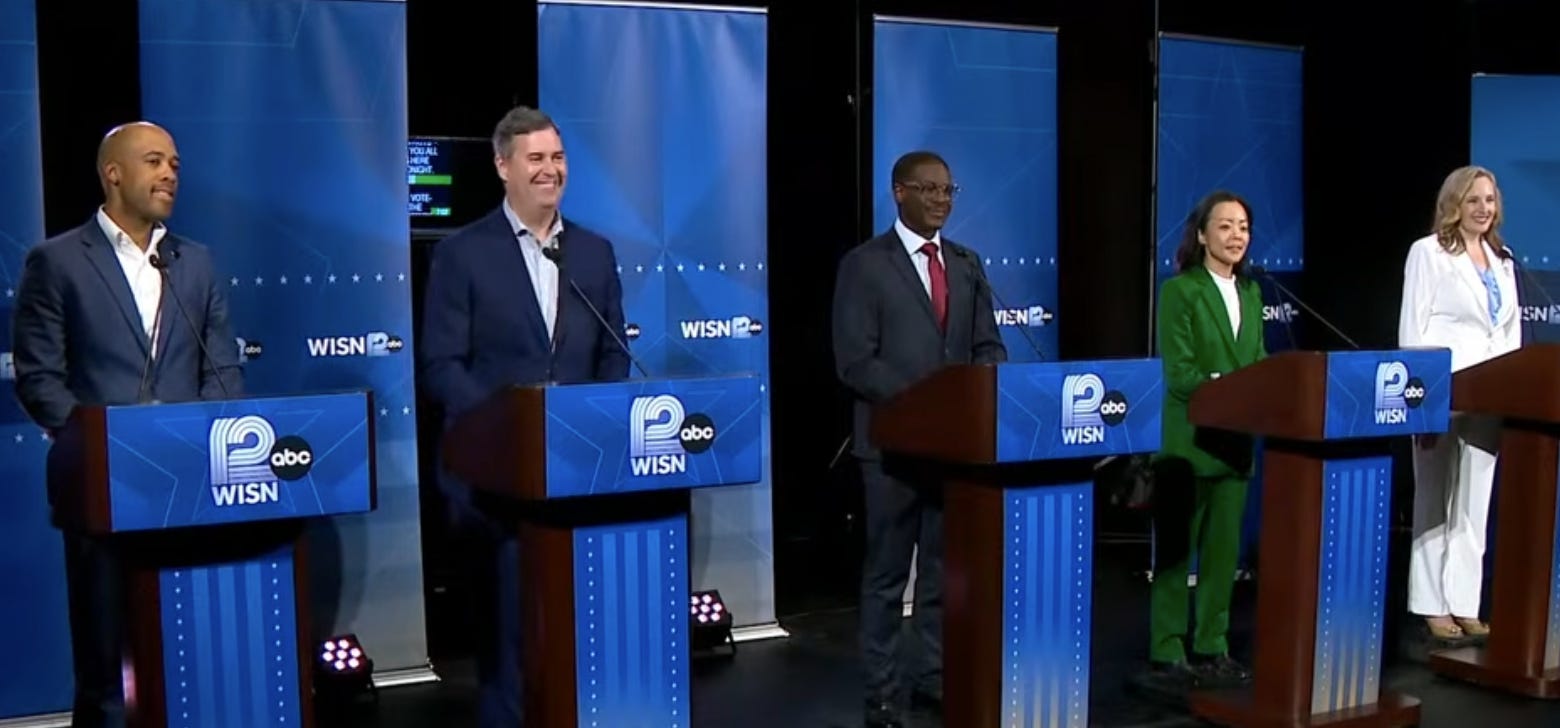
In the Democratic gubernatorial primary, where so much about the race has changed so dramatically over the course of the last few weeks, there is only one formal debate scheduled to be held before the Aug. 11 partisan primary.
Hosted by WISN 12, the event was held at Marquette University’s Weasler Auditorium, moderated by Matt Smith and Gerron Jordan. Smith and Jordan did a terrific job moderating, and Marquette is always a wonderful host for these big political events.
You can watch the full debate here:
Candidates, from left to right alphabetically by last name, were former lieutenant governor Mandela Barnes, former Department of Administration secretary Joel Brennan, Milwaukee County Executive David Crowley, State Rep. Francesca Hong, and State Sen. Kelda Roys.
I was there in the balcony watching in person with the rest of the assembled media, and spent some time in The Spin Room with the candidates after the debate. So, first, what I have for you is a few of my takeaways from the debate. Then, I’ll share some of the quotes from the candidates in The Spin Room — those will be for paid subscribers only.
Let’s recombobulate.
1. This felt more like a forum than a debate
Over the course of the last few months of this campaign, there have been many, many forums. I have lost count of how many forums have been held. We held the first major forum at The Cooperage in January, and dozens have happened since.

So, with this being the only debate debate scheduled to occur before the Aug. 11 primary, this offered candidates a unique opportunity to differentiate themselves from their fellow candidates. There can be only one winner.
Plus, the conversations surrounding the campaign have upped the spice level in recent weeks, and with that in the background — amid the chaos of everything that has transpired since that fateful Sunday night press release from Sara Rodriguez’s campaign — it was not unreasonable to expect some fireworks.
But that’s not really what happened. As they have in so many forums, the candidates again demonstrated how much commonality there is among the field on the issues. At times, when you’d see one candidate speaking, the others would be nodding in agreement. In questions on public education, taxing the rich, lowering property taxes, and funding local government, there was a lot of broad agreement on many of these issues. To a certain extent, that’s to be expected — they’re all running for the nomination of the same Democratic party, after all.
But by this being a debate, and not a forum, it offered an opportunity for these candidates to really show why they stand out from the field — how they differentiate, what’s a signature issue that might set them apart, how they might take a different approach to governing, etc.
In large part, that opportunity didn’t seem to be seized. Crowley was the lone candidate saying he’d have signed the surplus spending bill proposed by Gov. Evers and Republican legislative leaders, Brennan took a different approach than others when it comes to voucher schools in Milwaukee, but outside of Barnes taking a couple jabs at Crowley over the manner in which he returned to the race late in the debate — “The County Executive had his campaign resurrected by special interests in a dark room with people with their thumb on the scale,” he said — there really weren’t any direct criticisms between candidates.
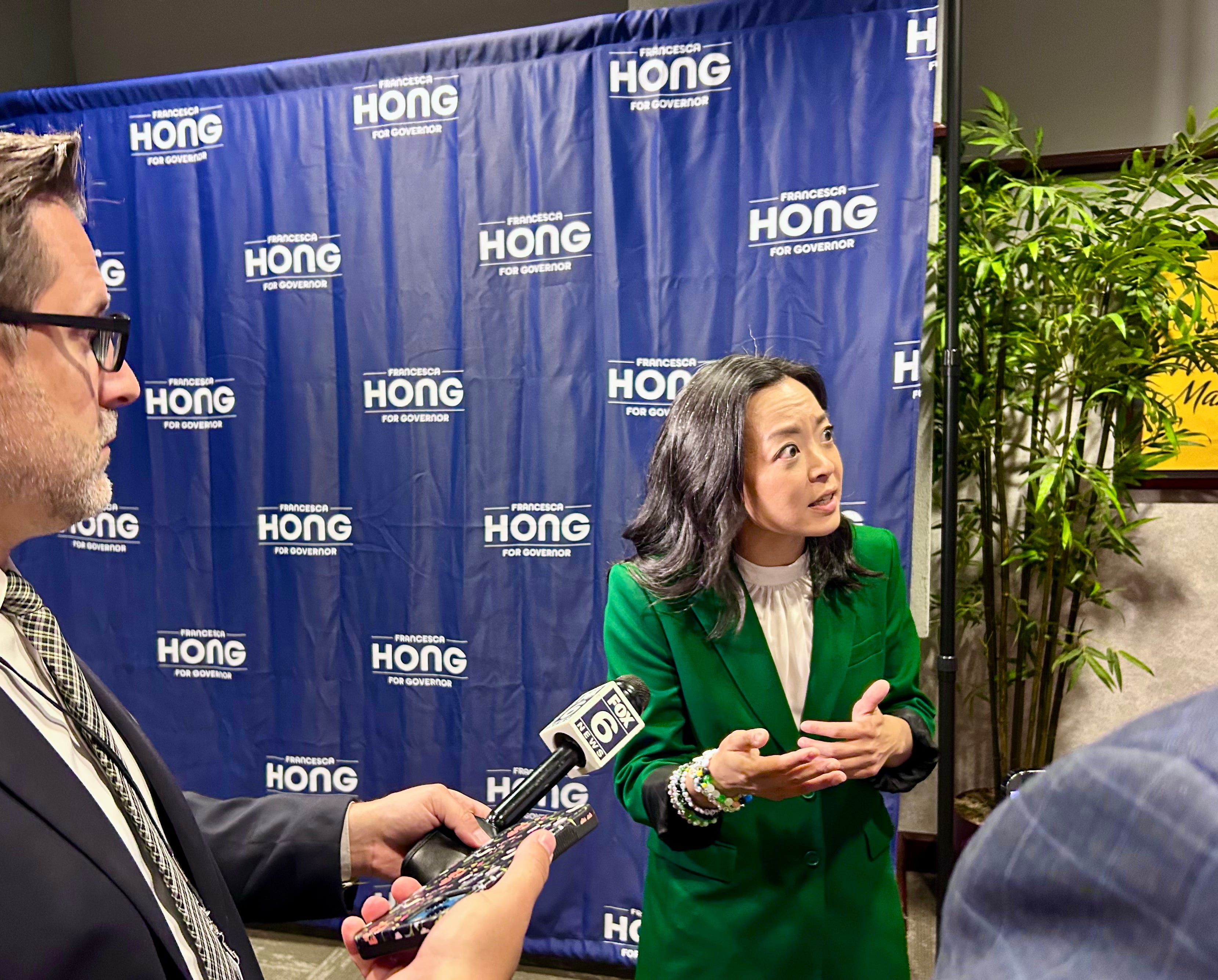
That seemed especially surprising coming on the heels of the new State Navigate poll released earlier that day showing Hong with a sizable lead over the field. And even on what is almost certainly her most vulnerable issue — police and public safety — no candidate went after her directly, which seemed like a missed opportunity for those seeking to defeat her.
So, ultimately, this seemed like yet another forum. A faster-paced forum with shorter answer times constrained into the one hour of the event, but a forum nonetheless.

2. Hong got on base
If the polls are to be believed, Francesca Hong has a sizable lead in this primary. Right now, it seems like her race to lose.

Given that position, she did not need to be attacking other candidates, and she did not need to be hitting any home runs. She just needed to get on base. And what did she do? She got on base.
As I’ve been saying for months, when you actually listen to the things Francesca Hong is saying, she is not the “f***-the-system!”-type insurgent that she’s been characterized as. If anything, this debate demonstrated how many of her positions are fairly mainstream among Democratic candidates, and she is often measured and thoughtful in the way in which she answers questions. To be sure, she is comfortably to the left of the rest of the field, but not so much so that she seems out of step with any of the more traditional Democrats in the race.
She navigated the inevitable defund/abolish police and socialism questions reasonably well — a definitive “No” to a question asking if she would sign a bill that would cut funding for police departments; a response putting some distance between her campaign and the national Democratic Socialists of America organization — and didn’t crumble in a high-profile setting like this one. She even seemed — dare I say — maybe a bit boring? That has to be a bit of a narrative-buster for some.
But ultimately, this night has to be viewed as a win for Hong. She didn’t make any major mistakes, her fellow candidates didn’t directly attack her, and she did what she needed to do as the frontrunner — she got on base, and didn’t strike out.
3. Mandela Barnes reminded us that he’s a strong debater
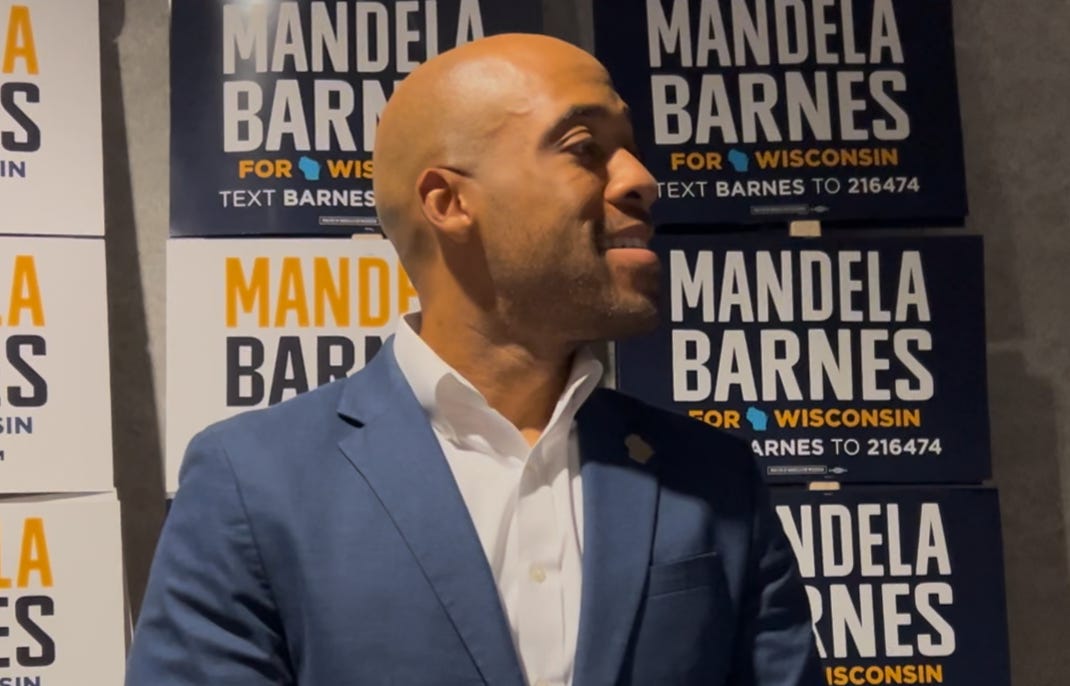
In a vacuum, the candidate to perhaps be considered the “winner” of the debate might be Mandela Barnes. He seemed more comfortable in a debate setting than the rest of the field — cracking jokes on stage before the cameras started rolling, delivering lines with charisma, and, well, evading direct answers on certain questions, as experienced politicians tend to do. But still, Barnes may have delivered the most compelling individual performance in the debate.
It served as a good reminder that Barnes is a strong debater. People tend to forget that, in his race against Ron Johnson, he fought through the absurd onslaught of ads to deliver a solid debate performance, helping close the gap on what was then a six-point lead for the Republican incumbent, giving himself a chance in the end, despite ultimately coming up short. He beat Ron Johnson in both debates four years ago. He did quite well in this one, too.
“There’s not a person on this stage that’s united all shades of blue in the Democratic Party as I have before,” he said, responding to his first question of the night, and that was a strong line — and what many voters are looking for right now.
The problem for Barnes, however, is that this debate does not exist in a vacuum. Crowley’s re-entry seems to be hurting Barnes’ chances more than other candidates, and Hong continues to ascend. Even in the post-debate press scrum, he declined to directly criticize her — “She’s been a friend. I supported her, she supported me,” he said.
With Hong owning the socialist-left flank of the field, and Crowley now rising in more of a center-left position after Rodriguez’s campaign implosion, Barnes is, as one Democratic strategist put it, “remaining stuck in the middle.” Barnes’ debate performance may remind people why they were excited to vote for him four years ago and why he can be a compelling candidate, but a whole lot has changed in four years, and the path to victory for Barnes at this stage still seems murky.

4. The non-Hong candidates each make their cases on leadership and experience
Among the four candidates who are not Francesca Hong, a persistent theme in their respective cases to voters centered around leadership. For Barnes, he highlighted his time as lieutenant governor, and the statewide political experience he gained in his 2022 run for U.S. Senate. For Brennan, it was about the work he’d done in the Evers administration, taking on issues like COVID-19 response and renegotiating the Foxconn deal. For Roys, it was “experience in and around state government” and turning progressive ideas into law, knowing her way around the ins and outs of how Madison works. For Crowley, it’s in leading county government in Milwaukee, the “second largest government in Wisconsin,” and delivering results on issues like Act 12 that required negotiation and compromise with a Republican-controlled legislature.
All of these cases are more than valid. These are accomplished leaders, and each can make a case to be an effective governor based on their executive or leadership experience — all, frankly, moreso than Hong can.
But it’s hard to see how any of these cases to be made on experience in leadership from these four candidates can clearly rise above their competitors. Each of these leadership cases make sense, but none is uniquely positioned to separate from this group of four on that issue alone. At a certain point, you have to play to win.

5. This is still a tremendously qualified group, and any of them would be better than Tom Tiffany
After moderating the first major forum of this gubernatorial primary election cycle back in January, I wrote about how this is a tremendously qualified field of candidates, and this primary demonstrated the Democratic Party’s strong bench in Wisconsin.
ICYMI:

Despite the tumultuous last few weeks we’ve experienced in this campaign, the bigger picture remains the same: any of these five qualified candidates would be light years better than Tom Tiffany as governor.
That was made abundantly clear on that debate stage. A generation of Republican control of the state legislature — from the trifecta control they enjoyed with then-governor Walker to the obstructionist absurdity they’ve deployed under Gov. Evers — has left so many issues unaddressed for years, and a Democratic governor and a Democratic legislature could truly transform this state for the better.
This election is the fork-in-the-road moment for Wisconsin. This is the first open race for governor since Walker was elected in 2010, and the first set of state legislative elections fully held under new maps.
This is it, folks. This is the culmination of years and years of effort, a position Democrats have put themselves in by winning election after election since their nadir in 2016 (Trump winning) and 2017 (not even fielding a candidate in the state Supreme Court race). The Blue Wave in 2018. Rebuilding the Blue Wall in 2020. Two-term Tony. Flipping the state Supreme Court. The Wikler years. The new maps. It has all led us here. Any of these candidates would be demonstrably superior to Tom Tiffany in just about every conceivable way. Any one of them could win.
This is a terrific field of candidates, and a remarkable opportunity for voters — yes, the voters — to choose the next path forward.