

The Recombobulation Area is a 19-time 21-TIME! Milwaukee Press Club award-winning opinion column and online publication founded by Milwaukee journalist Dan Shafer.
This is a joint guest column by longtime contributor to The Recombobulation Area, Angela Lang, the co-executive director at Black Leaders Organizing for Communities (BLOC), and Nada Elmikashfi, who currently works as the Chief of Staff in the Assembly office for State Rep. Francesca Hong.
Full disclosure: BLOC has issued a joint endorsement for Hong and Milwaukee County Executive David Crowley in the race for governor.
Ideology is not the only thing we listen for when we’re considering a candidate.
One of the most compelling arguments for or against someone running for office can be their communication style. How they present their ideas — and to whom — can be very good indicators of what their leadership will look like once in office.
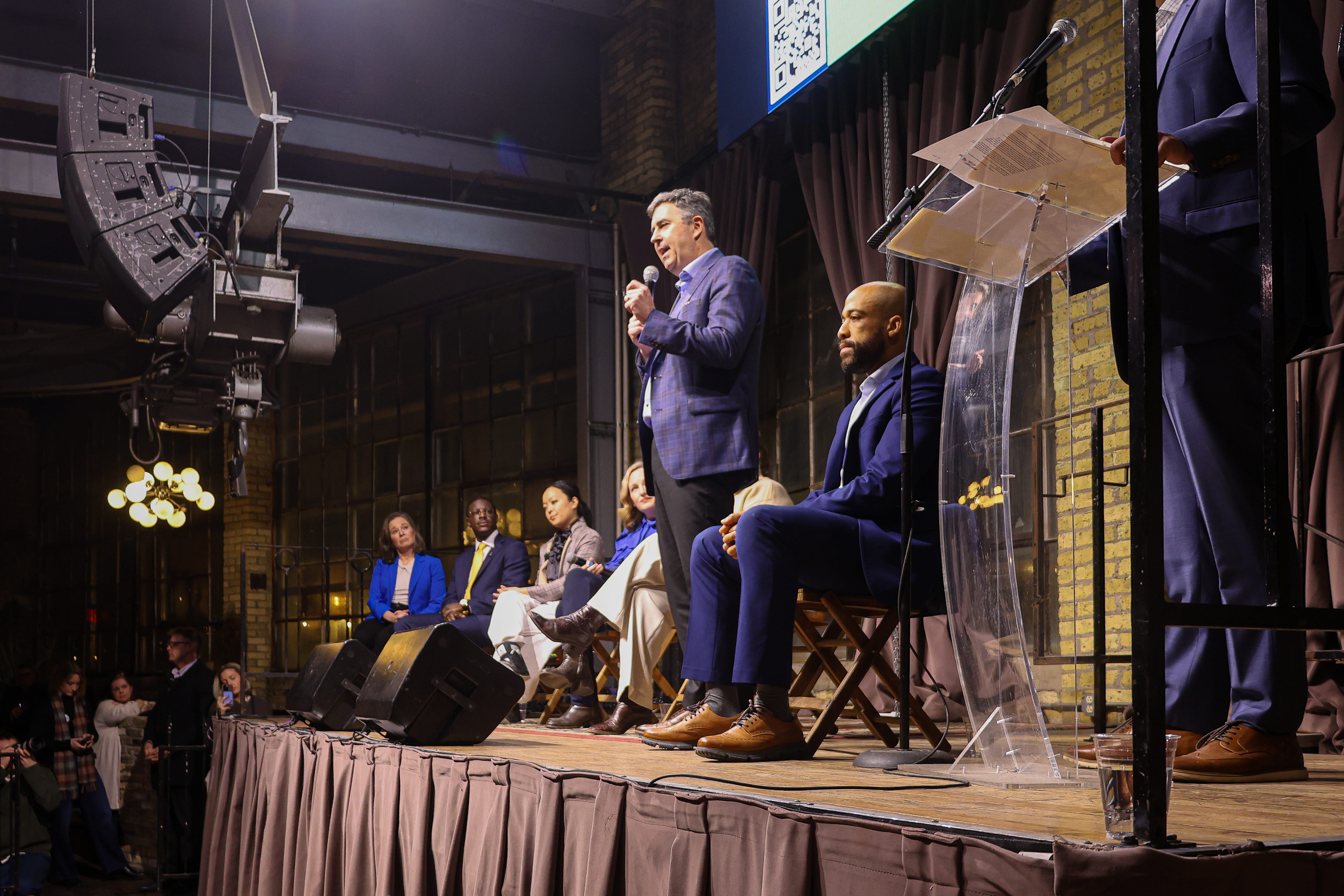
That’s why gubernatorial candidate Joel Brennan’s recent ad caught our attention. In it, he labels the rest of the field as unelectable, and only highlights the candidates of color, State Rep. Francesca Hong, former lieutenant governor Mandela Barnes, and Milwaukee County Executive David Crowley, while leaving out State Sen. Kelda Roys.
Roys, like Brennan, happens to be white. Her exclusion from the ad was noticeable, and some folks attributed it to her not being a front runner in the race. But for Joel Brennan — who has consistently polled at the bottom of the field — anyone consistently doing better than him is notable competition.
This signaling out of candidates of color also comes after past remarks that Wisconsin isn’t ready for a non-white governor.
A clear pattern of communication has emerged: Joel Brennan has implied more than once that the color of a candidate’s skin is a detriment to Democratic electoral success.
“They’ll all lose to Republicans in November,” Brennan says in that startling campaign ad. “I will win in November, and I’ll never quit on Wisconsin.”
Fortunately, it’s unlikely that any of these things happen. Just recently the Marquette Law School Poll had him at a measly 2% with registered voters.
And in touting his white centrism — deliberately or not — as the most electable thing about him, Joel Brennan has indeed already quit on the Wisconsin that looks like us — Black women, Democrats, voters.
But this is nothing new. Wisconsin consistently has had an “electability” dogwhistle problem. Every time there is a candidate of color running statewide we hear this sneaky line suggesting, I like them but I just don’t think they can win. We heard it during Mandela Barnes’ recent U.S Senate race, where he came within 1% of ousting incumbent Senator Ron Johnson during a difficult cycle and while being abandoned by national Democrats. Mandela was perceived as being “too black to win” and it became a self-fulfilling prophecy. Rather than matching their concerns with the support to overcome them, much of the white political establishment simply accepted that racist narrative.
Surely this is not the way to move forward towards change and a more representative democracy that so many of us talk about.

The racism and misogyny in this race, while appalling, is nothing new in Wisconsin. It is exciting to know that there is a very real possibility that Wisconsin could elect its first governor of color or first woman of color. And at the same time, we have not seen more racist and misogynistic comments in a campaign in recent memory. Analysis went from dogwhistle to bullhorn with Brennan saying the quiet part out loud.
We have also seen personal attacks. Supporters of one candidate personally attacking others on social media. We’ve seen it time and time before on the national level but nothing this nasty statewide. People have strong feelings, we get it. Cycle after cycle we say this is the most important election of our lives — but this actually feels like it this time. Challenges on election day are a very real possibility, and we all know that our futures hinge in the balance and it feels like life or death for marginalized communities.
Wisconsin has a late primary. There are 84 days between the primary and the general election, and now is the time for folks who identify as Democrat — or even left of that — to check their own biases. We’ve seen vile social media posts questioning people’s values and posts full of racism and misogyny.

Another dog whistle of sorts popped up in the word “establishment.” Black voters supporting a candidate are now deemed “establishment” and their political analysis written off because of it. What does establishment even mean in a race with these types of dynamics? We’ve heard David Crowley question how growing up in Milwaukee’s 53206 ZIP code can make him the “Democratic establishment.”
There’s a point there. Organizers and activists are looking to build power, be in rooms, and have a seat at the table. By the time we get there, and experience even a little power — suddenly, we’re written off as “establishment.” It sends a message that there is a ceiling for Black political power. If you sit in a room with DNC chair Ken Martin, then suddenly you are “establishment.”
Aren’t we trying to get in the room with stakeholders? Shouldn’t we be proud that a kid from 53206 has gotten to the level of getting the governor’s endorsement?
We also can have nuance to these conversations. We know that sometimes when people do make it out of the hood, they do switch up, and there is a new class of proximity you can be a part of. How marginalized people navigate that experience is important. The “establishment” conversation is an important one and we are glad it’s happening, but let’s also unpack what people are really trying to say and approach these conversations with care and nuance.
“Electability” and “establishment” have become words to weaponize against candidates of color. Organizers have called out for years how racist the “electability” conversation has been. We have seen it in our state Supreme Court races, and in the last U.S. Senate race with Mandela Barnes.
Wisconsin unfortunately isn’t a stranger to these types of frustrating conversations, cycle after cycle, but we can actually live up to our state motto and move “Forward.” The top three front runners are candidates of color and a woman of color. Wisconsin could very well make history, and we should be embracing it. The voters of Wisconsin have an opportunity to advocate for their candidate without getting into dogwhistles. We are hopeful that we all can have more nuanced conversations, and make sure we beat Tom Tiffany in November.

Subscribe to The Recombobulation newsletter here and follow us on Facebook and Instagram at @ therecombobulationarea.
Already subscribe? Get a gift subscription for a friend.
Part of a group who might want to subscribe together? Get a group subscription for 30% off!
Follow Dan Shafer on Twitter at @DanRShafer, at BlueSky at @danshafer.bsky.social, and on Threads at @danshafer.
I actually really liked Joel Brennan when I met him, and even ranked him high in the ranked choice voting experiment (people assume he's centrist but he struck me as quite progressive). That said, his latest ad where he claimed everyone else would lose to Tom Tiffany in November totally turned me off. Fear mongering is not the way you win votes, sharing what you stand for is. I wasn't planning to vote for him in the primary anyway (feels like it would be a wasted vote), but after this recent negative/desperate move I think it's time for him to accept that he has no path to victory and drop out.
The one guy in the race who’s never won an election wants to tell the candidates who have how to win elections? Make it make sense.