

The Recombobulation Area is a 19-time 21-TIME! Milwaukee Press Club award-winning opinion column and online publication founded by Milwaukee journalist Dan Shafer.
Last week, we sent all of you an email inviting you to participate in “The Wisconsin Democratic Primary Ranked-Choice Voting Experiment.”
With the growth in popularity for ranked-choice voting, and with the likelihood that the winner of the upcoming Aug. 11 partisan primary may do so with a plurality of votes, we wanted to learn more about how this big-field primary contest might look in a different voting system.
It’s been quite a week to be conducting this experiment, given the events of the campaign.
Since we opened voting, one candidate left the race, another is embroiled in a massive campaign finance controversy, and the bigger picture surrounding this primary looks a whole lot different than it did just a week ago.
Nevertheless, the response from those of you who chose to participate in this experiment has exceeded our wildest expectations.
We kept voting open for a full week in hopes of getting a sample size of several hundred responses, and we had more than 1,000 responses (!) by the first night. Even after pausing voting when Milwaukee County Executive David Crowley dropped out of the race on July 8 (to collect the data) and reopening it July 9, we ended up with more than 2,100 valid responses at the end of the experiment.
We knew this already, but: You guys rule.
So, if you’re unfamiliar with ranked-choice voting, here’s how the process works. Voters rank the candidates on the ballot in order of preference. If a candidate does not win an outright majority of first-choice votes, the candidate with the lowest number of first-choice votes will be eliminated, moving to another round of tallying. In that next round, the second-choice votes of the eliminated candidate will be counted as first-choice votes, and on in subsequent rounds until a candidate has more than 50% of the vote and would be declared the winner.
To offer expert oversight of this process and to help with crunching the numbers, we worked with John D. Johnson, research fellow at Marquette University, who joined us for a live podcast to discuss the results (available for paid subscribers only).
But to be clear, this is not a scientific poll, this is a random survey from an online publication. Next week, the gold standard poll that is the Marquette University Law School Poll will be sharing the latest results on the race, and those are the results you should be taking seriously. This is (mostly) just for fun.
With that, it’s on to the results.
First, we’ll start with the first choice results. These fell overwhelmingly in favor of one candidate: State Rep. Francesca Hong.
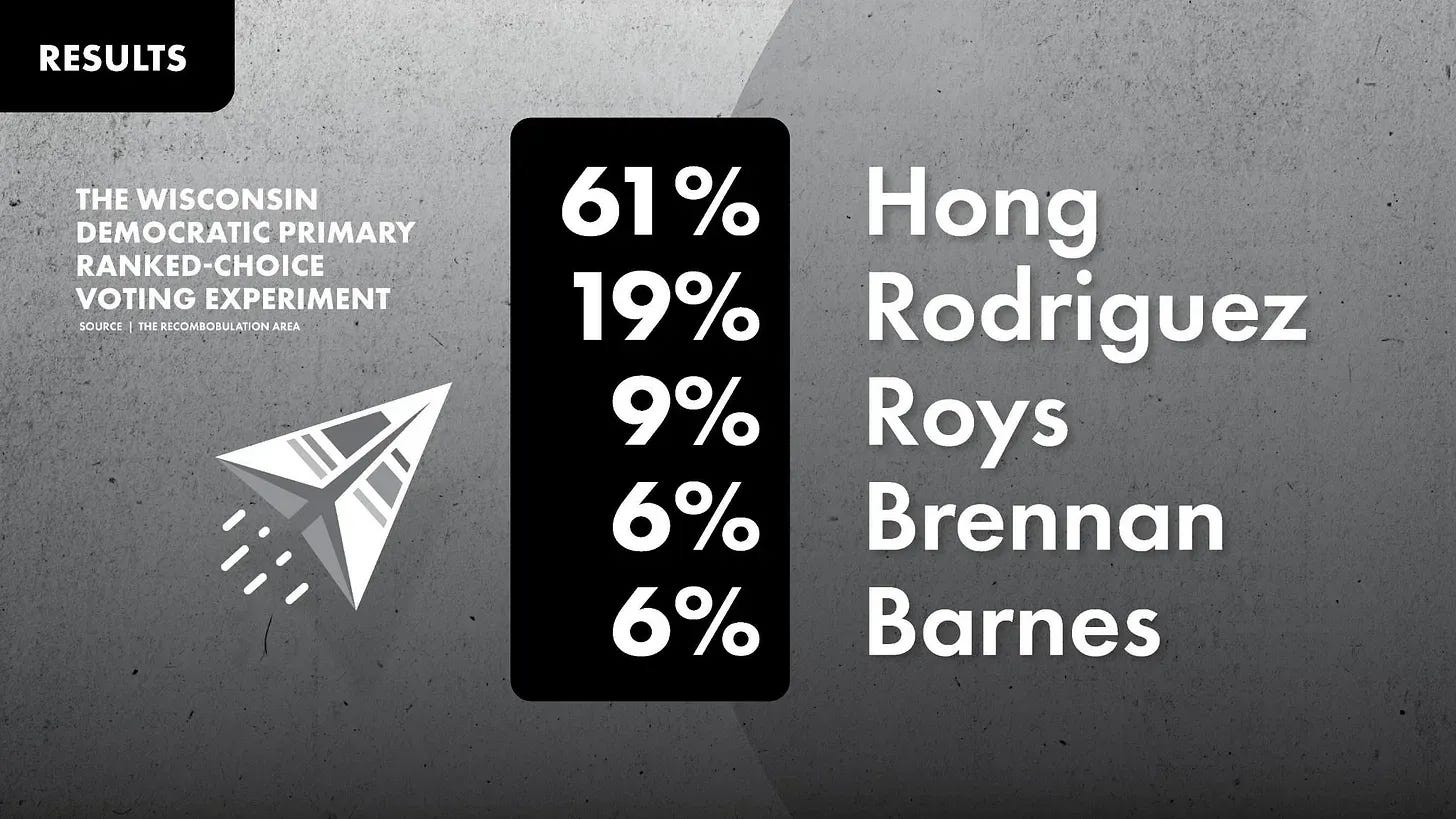
More than 60% of those participating in this survey selected Hong as their first choice. This puts her far ahead of any other candidate in this survey, with more than triple the votes of the next closest candidate. Lt. Gov. Sara Rodriguez came in second with 19% of first-choice votes, followed by State Sen. Kelda Roys at 9%, and former Department of Administration secretary Joel Brennan and former lieutenant governor Mandela Barnes each at 6%.
“Compared to other random samples, The Recombobulation Area respondents are far more likely to support Hong,” said Johnson.
Because Hong gained a clear majority of votes in the first round, there is no need for any subsequent rounds to eliminate lowest-ranked candidates and distribute their votes accordingly.
So, Francesca Hong is the winner of “The Wisconsin Democratic Primary Ranked-Choice Voting Experiment.”
She wins in a first-round knockout in convincing fashion. Perhaps there’s a generational aspect to these results, perhaps her supporters are more online, perhaps she is indeed lapping the field. Whatever it is, no recounts or subsequent rounds are needed, she is the winner.
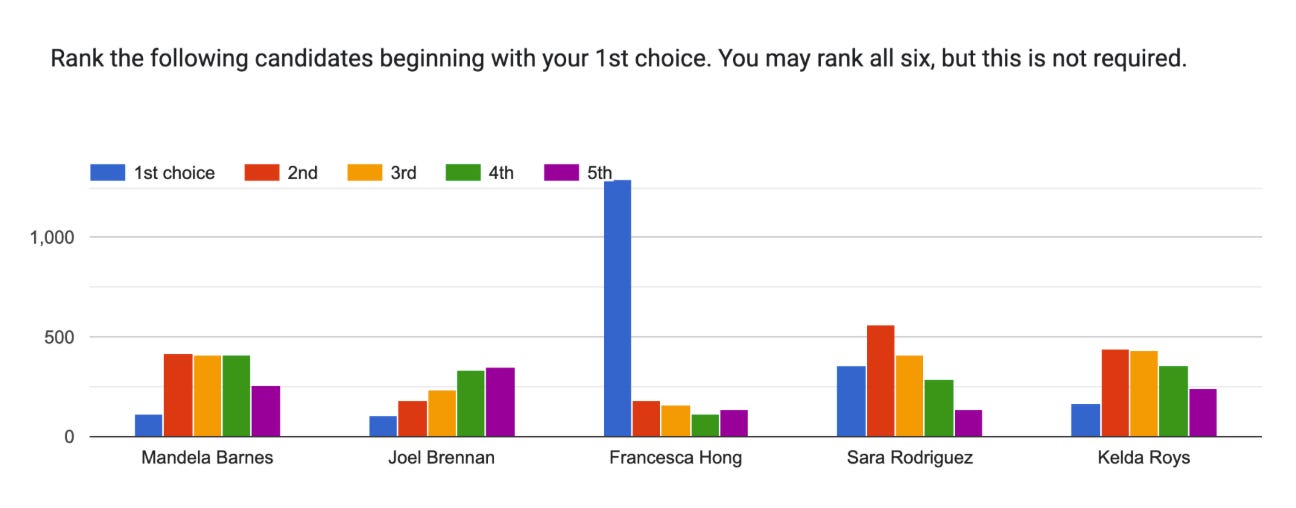
For another way to look at this, here’s how the results of this experiment were displayed in the Google Form.
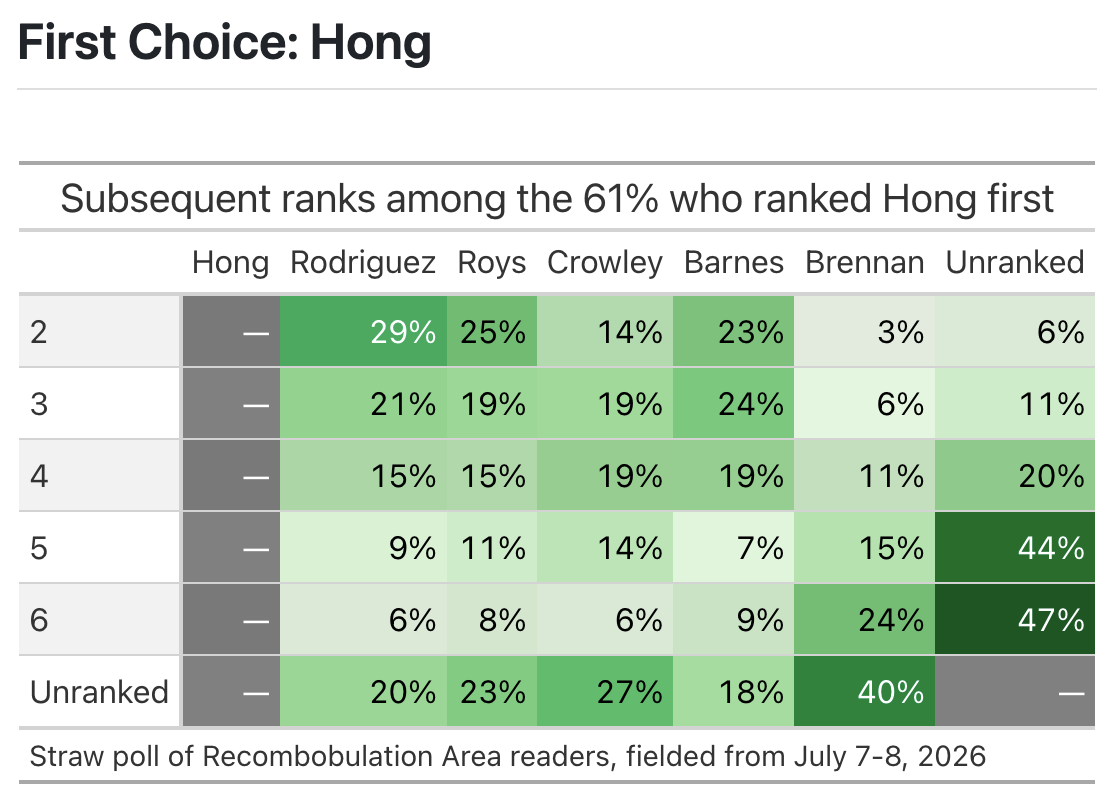
For the voters who ranked Hong first, here’s how they ranked the rest of the field:
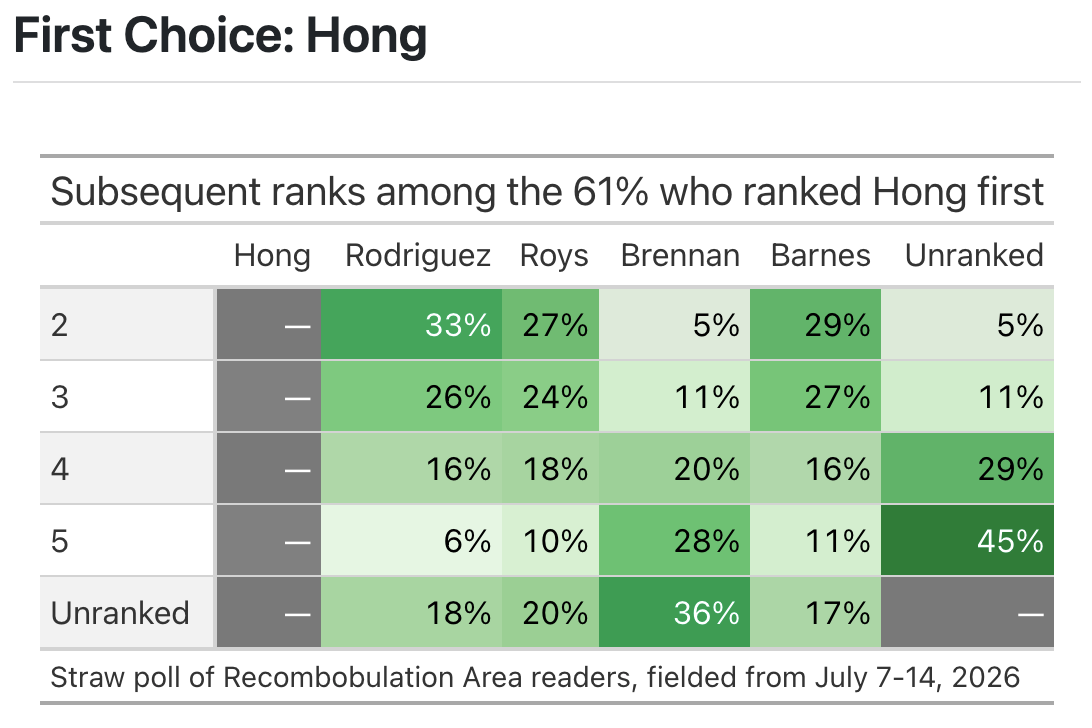
(Note: All of these First Choice / Subsequent ranks charts were made by John D. Johnson)
Second-choice selections were fairly evenly distributed between Rodriguez (33%), Barnes (29%) and Roys (27%), with only 5% of first-choice Hong voters ranking Joel Brennan second. In the full dataset of Hong voters, nearly half did not rank a fifth choice (or sixth choice, for the first day of voting).
During the portion of the poll when David Crowley was in the race, he gained 14% of second choice votes from those who ranked Hong first.
About David Crowley…
Because of the way ranked-choice voting works, he can be removed from the list of rankings without changing the larger dynamics of the process.
“So, if someone had selected Crowley first, that person’s second-place choice is their new first-place choice,” said Johnson, who reordered the selections after Crowley dropped out of the race.
With Crowley in the race, he ranked sixth out of the six candidates, with just 6% selecting him as their first choice. (This is limited to the people who responded before he dropped out.)
While that’s a fairly small sample size of first-place votes, Johnson also took a look at how those respondents ranked the rest of their ballot. Results here:
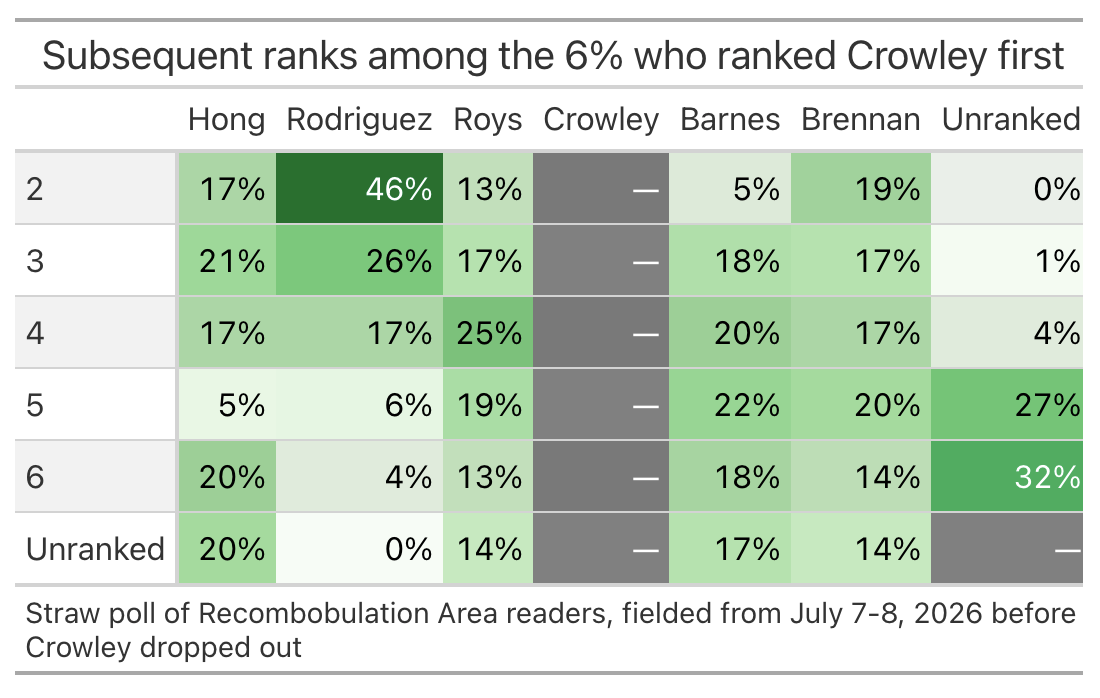
Here, we can see that nearly half of Crowley-backers (46%) ranked Rodriguez second, well ahead of the other candidates — Brennan (19%), Hong (17%), Roys (13%), Barnes (5%).
Notably, too, all of these results came before Crowley officially endorsed Rodriguez. We had paused voting before I broke the news of his endorsement, which officially happened on Thursday, July 9.
The most interesting of these rankings might be that Mandela Barnes had the fewest second-choice selections of Crowley first-choice voters, but again, this is a very small sample size.

So, how do the rest of the candidates look?
Let’s start with Kelda Roys, who just joined The Recombobulation Area podcast earlier this week to talk about her campaign.
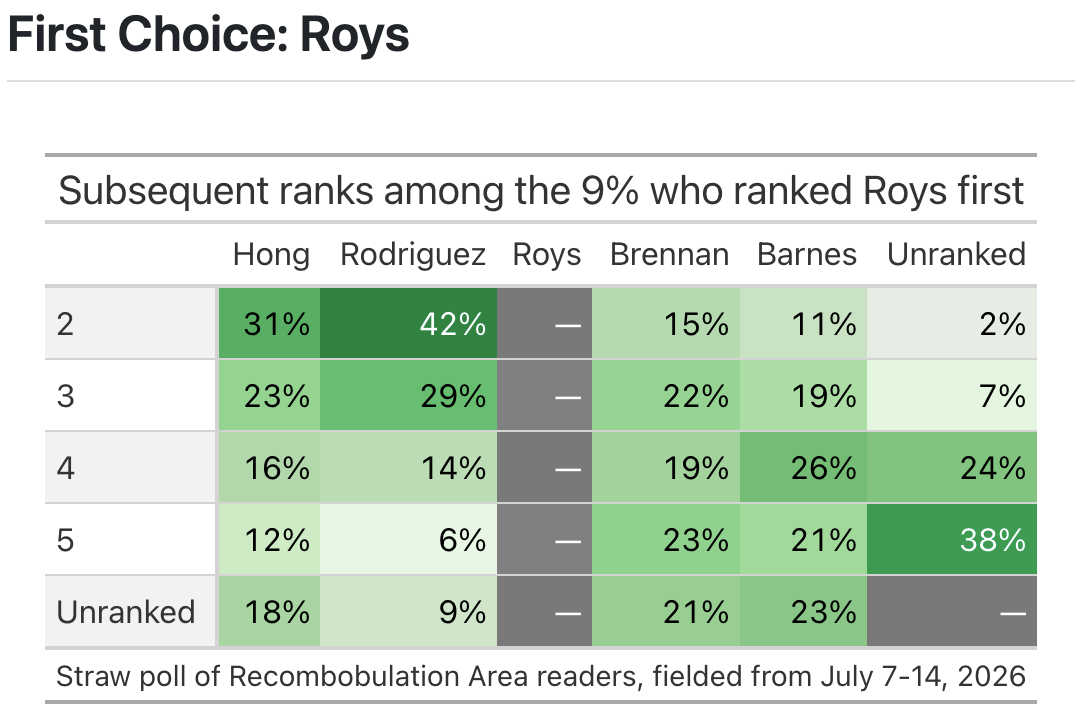
Roys received first-place votes from 9% of respondents. After that, the majority of second-choice rankings went to two candidates — Rodriguez (42%) and Hong (31%).
Roys and Hong represent many of the same voters in Madison, as Hong’s Assembly district is one of the three within Roys’ Senate district. So, perhaps that could explain some of why Hong has a significant number of second-choice votes here. It is a little bit surprising that Barnes ranks fourth here, as he and Roys would seem to occupy a similar non-socialist progressive lane, but then again, ideology isn’t everything.
Next up, Mandela Barnes.
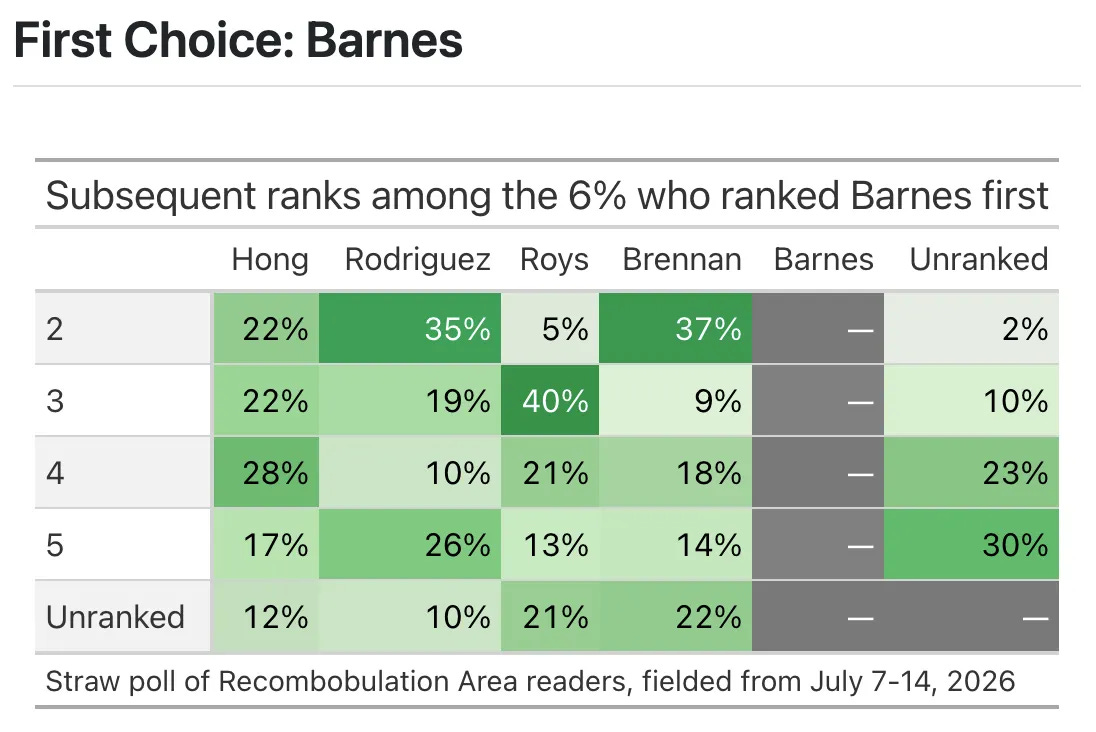
The former lieutenant governor and 2022 U.S. Senate candidate was ranked first by 6% of voters, and of those, most ranked either Brennan (37%) or Rodriguez (35%) in second.
Interestingly, only 5% of first-place Barnes voters ranked Roys second, but 40% ranked her third, more than any other candidate. The inverse was the case with Brennan, who had a large number of second-choice votes, but the fewest third-choice votes.
As Johnson noted in our live podcast discussing the Barnes results, “I don’t really know what to make of this…It seems kind of all over the map to me.” It sure does.
Next up, Joel Brennan.
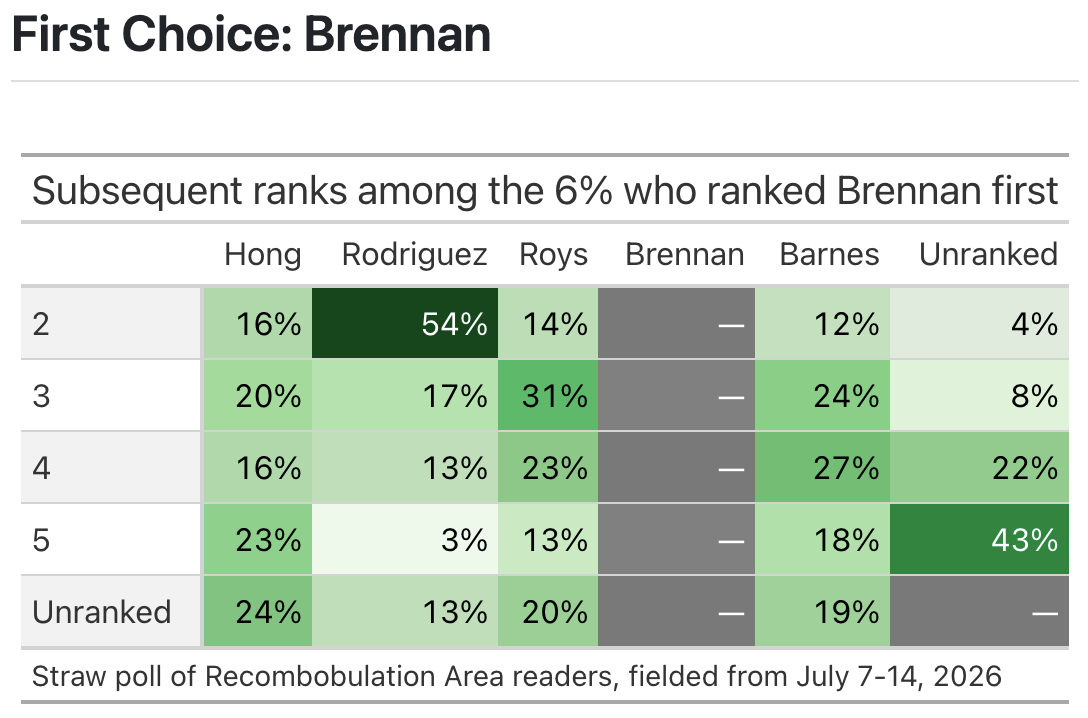
The former president and CEO of Discovery World had 6% of first-place votes, and the majority of his second-place votes went to Rodriguez (54%), with the rest fairly evenly distributed between Hong (16%), Roys (14%) and Barnes (12%).
With several candidates showing Rodriguez ranking second, you can see the outline of a coalition forming. Brennan and Crowley’s second-choice voters were going to Rodriguez. Many of Roys’ and Barnes’ were, too. She seemed to be emerging as the alternative to Hong.
That was, well, until Sunday night, when Rodriguez announced she was firing her campaign manager after what’s being revealed to be a massive campaign finance controversy.
So, perhaps it is of particular interest now who her first-place voters might have the rest of the field ranked.
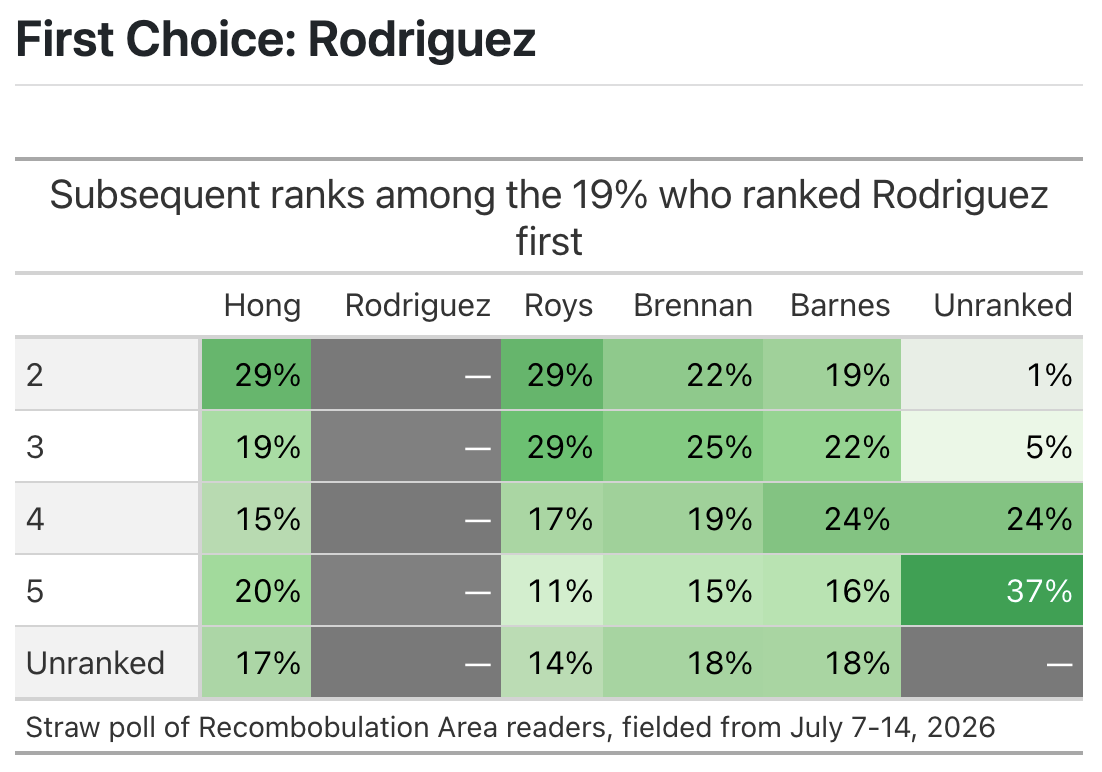
Of Rodriguez first-choice voters, Hong and Roys tied with the most second-choice votes at 29%, followed by Brennan at 22% and Barnes at 19%.
Clearly, Hong has a whole lot of fans here among Recombobulation Area readers, so it doesn’t seem all that surprising that she pulls a high number here. But it does cut against the ideological composition of some of these results that she is the second choice of many Rodriguez backers.
The more interesting result, to me, is that Roys had a slight edge over Brennan and Barnes in among these Rodriguez second-choice voters. It’s not a huge advantage, but this is a larger sample size than some of the rankings for other candidates, making that 7-10% edge a bit more legitimate. Someone is going to stand to gain from the Rodriguez campaign’s implosion. Could it be Roys? Or, could this just mean that the Hong campaign is in even better shape, poised to win this primary?
We’ll soon find out. But as we’ve seen, this campaign can turn rather quickly.
All of you here have been part of this experiment, too. What do you think? What are your takeaways from these results? Leave a comment below, or shoot us an email at therecombobulationarea@gmail.com.

Dan Shafer is a journalist from Milwaukee who writes and publishes The Recombobulation Area. He worked with Civic Media from 2024 to 2026. He’s written for The New York Times, The Daily Beast, Heartland Signal, Belt Magazine, WisPolitics, and Milwaukee Record. He previously worked at Seattle Magazine, Seattle Business Magazine, the Milwaukee Business Journal, Milwaukee Magazine, and BizTimes Milwaukee. He’s won 24 Milwaukee Press Club Excellence in Journalism Awards. He’s on Twitter at @DanRShafer.
Subscribe to The Recombobulation newsletter here and follow us on Facebook and Instagram at @ therecombobulationarea.
Already subscribe? Get a gift subscription for a friend.
Part of a group who might want to subscribe together? Get a group subscription for 30% off!
Follow Dan Shafer on Twitter at @DanRShafer, at BlueSky at @danshafer.bsky.social, and on Threads at @danshafer.
With Sara’s campaign potentially imploding, I wonder if Roys becomes a dark horse, particularly because she was the candidate of choice for many progressives in ‘18, while now having multiple terms of experience as a state senator.
[This would probably require all of the other past and current candidates (besides Hong) to drop out and support her, which seems unlikely to happen; particularly in Barnes’ case.]
While I like Hong, this survey is only indicative of whom your viewers prefer. Most Democrats are not online with you.