

The Recombobulation Area is a 19-time 21-TIME! Milwaukee Press Club award-winning opinion column and online publication founded by Milwaukee journalist Dan Shafer.

…AND, WE’RE BACK!
Readers, thank you so much for bearing with me over the past few weeks as I’ve done some of my own recombobulating. I do appreciate it. And thank you, too, for the wealth of wonderful questions you’ve sent in over the past week to help me recombobulate. We do appreciate it.
And, in case you missed it, we re-ran some posts from our archives while I was away. Here are those.


OK then, let’s get right to your questions then. Let’s recombobulate, together.
QUESTION:
What do we make of the opposing data center dynamics between the WI-3 and gubernatorial race? In Western Wisconsin, Cooke has come out in favor of a data center moratorium and is driving a lot of attention to DVO’s (and Trump’s) pro-data-center policies. Meanwhile, in the governor’s race, Tom Tiffany has successfully saddled David Crowley with the pro-data-center label (and, over the past week, the pro-Flock label). Certainly Tiffany is lying, but that’s not the point — Crowley seems committed to answering with pages of ambiguous regulations and both-sidesy public statements. This race is of existential importance to the future of Wisconsin, and data center and Flock camera issues alike target the exact swing populations Democrats constantly claim they need to win over (though usually that’s through moderating their progressive positions). Why won’t Crowley read the room and speak definitively on these issues? The state revenue projections from data centers are shaky at best. Democrats across the country and across Wisconsin have seized on this as a winning issue: are the trade union endorsements, which certainly aren’t going to go to TT, so valuable that he’ll really let himself get outflanked by a Trump lackey? I voted for Francesca Hong in the primary and will certainly vote for Crowley in November, but it’s getting distressingly difficult to evangelize the merits of a candidate who won’t touch bipartisan flagship issues.
“Desperately Seeking Fusion,” via email
Long time, first time. I have two related questions about the Governor’s race this year. On the issues of Data Centers and Flock Cameras, I am worried that Tiffany is successfully outflanking Crowley on what should be left of center policy positions.
On Data Centers, Tiffany is already up on TV calling Crowley “Data Center David”. A recent article in the Journal Sentinel somewhat confirmed that Tiffany is taking a more aggressive stance because he supports repealing the data center incentivising tax credits passed in the last budget, while Crowley does not. My educated guess would be that Crowley may be reticent to oppose these tax credits because of his reliance on support from the building trades labor groups who want those construction jobs to keep flowing into the state. On Flock Cameras, a (recent) story in the Milwaukee Journal Sentinel caught my eye: “Tiffany proposes barring cities from using state shared revenue for Flock cameras”. I can confirm Flock cameras are on the minds of voters, but I have heard push-back from Democrats in Wisconsin who shy away from coming against them out of fear of alienating the local police unions or the public safety minded voters who may be convinced by the, not totally baseless, argument that this technology is helping bring down crime rates in American cities.
These both seem like examples of how Democrats are punished politically for our well-intentioned deference to interest groups within our coalition, while Republicans can take whatever position will get them ahead and still promise the monied interests behind closed doors that support them that they won’t actually govern that way. What are your thoughts about how Democrats vs. Republicans manage their coalitions and what should Democrats do to get on the right side of these two issues without alienating labor groups or the police/public safety minded voters?
Sean in Racine, via email
ANSWER:
Perhaps this is a product of stepping away from the grind of the day-to-day news cycle for a couple weeks, but when it comes to these matters of data centers and Flock cameras, I think people might need to pour themselves a nice pitcher of Settle Down Juice (copyright: Bill Simmons) on these issues.
That’s not to say these aren’t especially important topics to voters in 2026. Data centers have clearly emerged as a significant campaign issue, and Flock cameras seem headed in the same direction. Francesca Hong’s moratorium advocacy in her campaign helped propel her into contention, and I think it’s the right policy to adopt at the moment on the matter — it’s not like Robin Vos’ legislature is going to do anything about them before the midterms anyway. Flock cameras, too, are creating a myriad of problems (see: this recent guest column from a member of the ACLU of Wisconsin) and politicians are right to pump the brakes on their use, if not halt them outright.
It’s not hard to find reasons to be particularly wary of Big Tech at the moment. Data centers, in particular, represent a sort of physical incursion of technology that hasn’t yet been seen in previous iterations of new developments that require broader adoption. It’s not like launching Gmail or Instagram carried with them headlines like “Anthropic insiders warn AI could kill all humans.”
Being against data centers and Flock cameras are not only the right positions to take on practical grounds, but represent good politics, too, as polls have shown broad opposition to them in ways that cut across traditional partisan lines. These do represent the types of 80-20, 70-30 types of issues that centrists are always saying Democrats should adopt.
But I do think it would be a mistake to overemphasize the importance of these issues in the broader context of all that is going to be on voters’ minds when going to the polls. Topics like healthcare, education and the economy — particularly inflation and affordability — are going to rank higher in importance for most voters.
Take a look at the most recent Marquette University survey of public opinion. Only 5% of voters rated data centers as their most important issue, not even in the top five of the ten issues included. Inflation and the cost of living, however, rated as the most important issue for 43% of voters. Health insurance had double the number that data centers did. Data centers were also outside the top five for voters’ second most important issue.
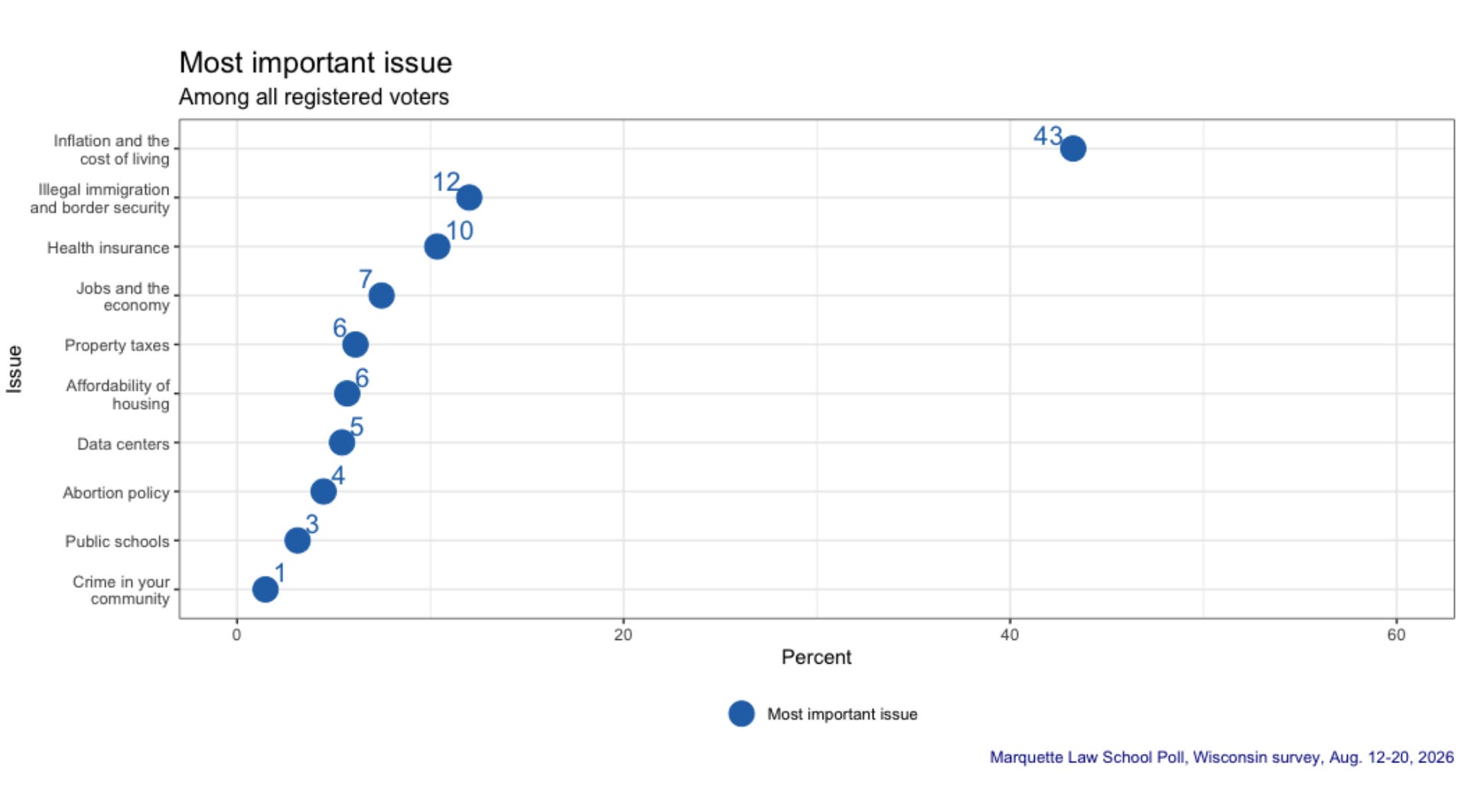
David Crowley’s victory in the primary seems proof positive of this, to a certain extent, too. If data centers were an election-swinging issue, shouldn’t Hong have won on the back of that position?
Plus: As our first emailer here suggested: Tom Tiffany has little credibility on this issue. The more he talks about it, the more attention people are going to pay to his own record on AI and data centers, and that is going to be a problem for him. Hong had credibility in her opposition; Tiffany doesn’t. Plus: it sure seems like Tiffany’s purported data center reluctance is in part a Trojan Horse for a broader opposition to renewable energy — also a bad policy in a time when we need across-the-board strategies to bring down energy costs and mitigate the effects of oil-related forever wars. And as Flock cameras have become an issue in the Attorney General race, both incumbent Democrat Josh Kaul and Republican challenger Eric Toney have criticized the surveillance systems, so it’s hard to see how this is a distinguishing issue for either candidate.
When it comes to Crowley and his campaign, specifically, could he be doing more to better speak to the issue on data centers, in particular, and meet voters where they are? Absolutely. But are data centers an issue that’s going to break him? I don’t think so. Of far greater importance will be issues like healthcare, education, affordability and so many more traditional topics. Most will vote on economic issues, and while every last vote matters in a state as evenly divided as Wisconsin, the evidence that this could legitimately swing an election seems suspect at best.
While I don’t disagree that this race is “of existential importance to the future of Wisconsin,” as our first emailer wrote, and that Democrats wary of “alienating labor groups or the police/public safety minded voters,” as our second emailer wrote, are playing it too safe regarding data centers and Flock cameras, people are being too hyperbolic about the electoral vulnerability that Crowley’s positions on these matters can pose.
Frankly, Hong’s socialist background would have presented a far greater polling risk than that of data centers, and her supporters tend to overlook this in this type of analysis. Her own poll numbers in the latest Marquette survey were disastrous, by the way. It would be a five-alarm fire of takes if those numbers had come out shortly following a Hong primary win. The Tiffany camp, which clearly wanted to be running against Hong, just seems to be playing the hand they’re dealt now — and their wild scrambling from socialism to any topic–of-the-week seems more flailing and desperate than any true success in outflanking an opponent.
Let’s all take a beat here. The quicksand of the daily news cycle is pulling too many down into a vicious cycle of never-ending pessimism. Being off on a buzzy, but ultimately not all that prominent issue is not going to spell the end of the Crowley campaign. Eyes on the prize, folks.
QUESTION:
I am wondering if you think the governor’s race is going to be a low-key bland election like Taylor-Lazar or a typical Wisconsin election coming down to city of Milwaukee absentee votes and a 1% victory? Not much excitement yet and not many people talking about it. I am strongly for Crowley but don’t see much enthusiasm on either side. Just curious on your thoughts.
Christopher Hansen, on Substack
Reader mail question: the recent humiliating losses by Lazar and Schimel seem to have broken several GOP media & influencers. Is Crowley doing enough to reach & motivate voters outside of Milwaukee and Madison? TY
Neil W, on Substack
ANSWER:
